Meet the Leadership
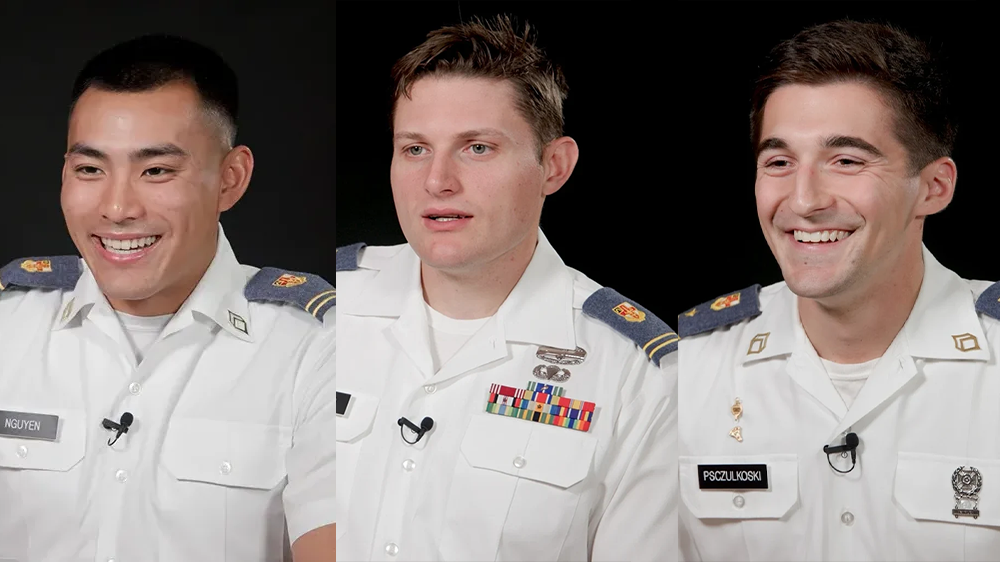
Kimlong Nguyen ’27 | Matthew Assouad ’27 | Aiden Psczulkoski ’27
Kimlong Nguyen ’27, Regimental Commander
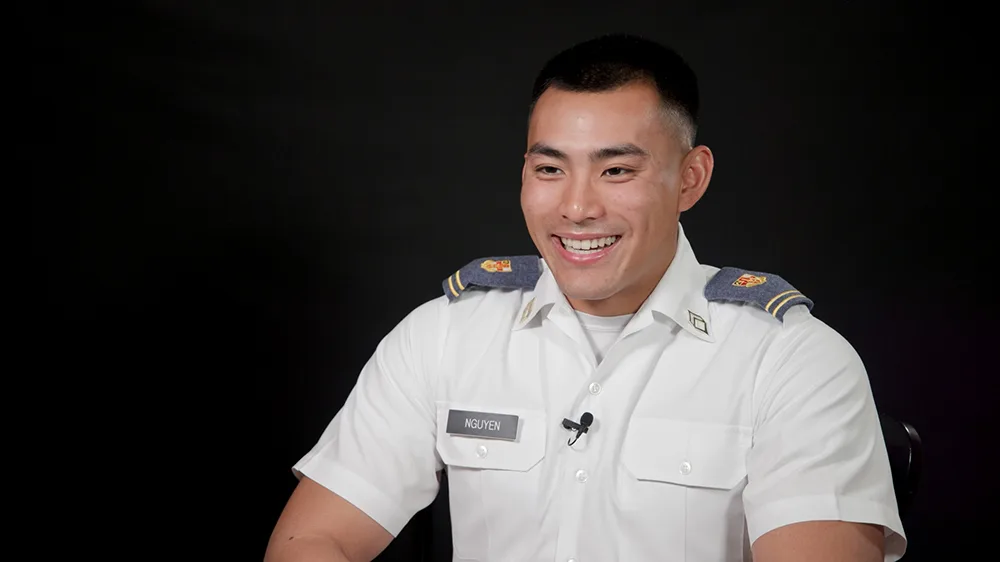
Hometown: Chantilly, Virginia
Major: Computer and Information Sciences
Commissioning: U.S. Marine Corps
Involvement on Post: Cadre member 3rd and 2nd Class years, swim and dive team member 4th and 3rd Class years.
Q: What’s interesting about your family?
A: “Both my grandfathers served for the South Vietnamese fighting alongside the U.S. in the Vietnam War, and that’s kind of how my whole family got here. …We were just escaping that war, and one of my grandfathers was actually a prisoner of war in that conflict.”
Q: What was your path to VMI?
A: “I grew up swimming, and originally, I committed to another Division I school. I knew a lot of people at VMI who were swimming here, especially a 1st Class cadet named Tommy Lees ’24. He’s in my dyke’s room, and seeing how VMI kind of developed him, and just knowing him all my life, and then now seeing him as a 1st Class cadet changed my perspective on what VMI can really do to a person.”
Q: What do you remember most about matriculation?
A: “I knew that after this day, my journey at VMI was going to start, and I wasn’t going to see my parents much, but it was going to be all worth it because I knew when I saw them again, I would be a different person.”
Q: What did you learn from the Rat Line experience?
A: “The further you lean into our system, the more you get out of that. And once you realize that’s actually a thing and people aren’t just saying it, then it really becomes rewarding. It becomes a reason why you stay.”
Q: Why did you apply to become regimental commander?
A: “Originally, I applied for the Alpha Company commander, but then, after a conversation with Colonel Faust [’96] and Sergeant Major Sowers, I ultimately decided to switch my application. I credit a lot of it to the regimental executive officer, as well. He’s played a big role in encouraging me to step up in these shoes and just try my best to apply for it. And so I did, and now I’m leading the school with some of my best friends.”
Q: What was it like to hear your name called in Memorial Hall?
A: “When I got my name called up, it was pretty crazy. I remember walking up the aisle, and everyone was super excited and everything. And it … really showed me that VMI has this great support system that fosters all your BRs to really cheer on all of us.”
Q: What would you like alumni to know about the state of the Corps?
A: “The state of the Corps is great. I think we have set a really high standard for the Old Corps—that often gets overlooked. But then we’re also involving a lot of the Old Corps in operations for the Rat Line for next year. Involving the whole Corps just sets that whole standard of we are one Corps, one VMI.”
Q: What do you want the Rat Mass of 2027+3 to understand?
A: “One thing I want the rats to mainly see is it doesn’t matter where you were before VMI. Once you get to VMI, we all start at zero, and from there you can do whatever you want at this school. I want them to know that whatever happened to them, or what they did or what they’ve done before VMI, none of that matters. What matters is how you attack this challenge for the next 4 years.”
Q: Why is VMI’s Honor Code so important?
A: “The Honor Code is obviously embedded in our school, and it has and always will be. It’s a single-sanction protocol. And what we’re really trying to teach the Corps is honor isn’t just at VMI. Once you leave VMI, it’s a lifestyle, and you carry it with you everywhere. I think VMI teaches you that lifestyle of just living honorably every single day with integrity.”
Q: When you lead the Corps this academic year, what will you be thinking about?
A: “This school has done so much for me. It’s transformed me from just some high school kid into this cadet. And now I really want to give back to the school and use the resources that the school gives us. It gives us all these opportunities to be a leader … and just really give back to the next generation.”
Editor’s Note: This interview was conducted in spring 2026, at the end of Nguyen’s 2nd Class year.
Matthew Assouad ’27, Class President
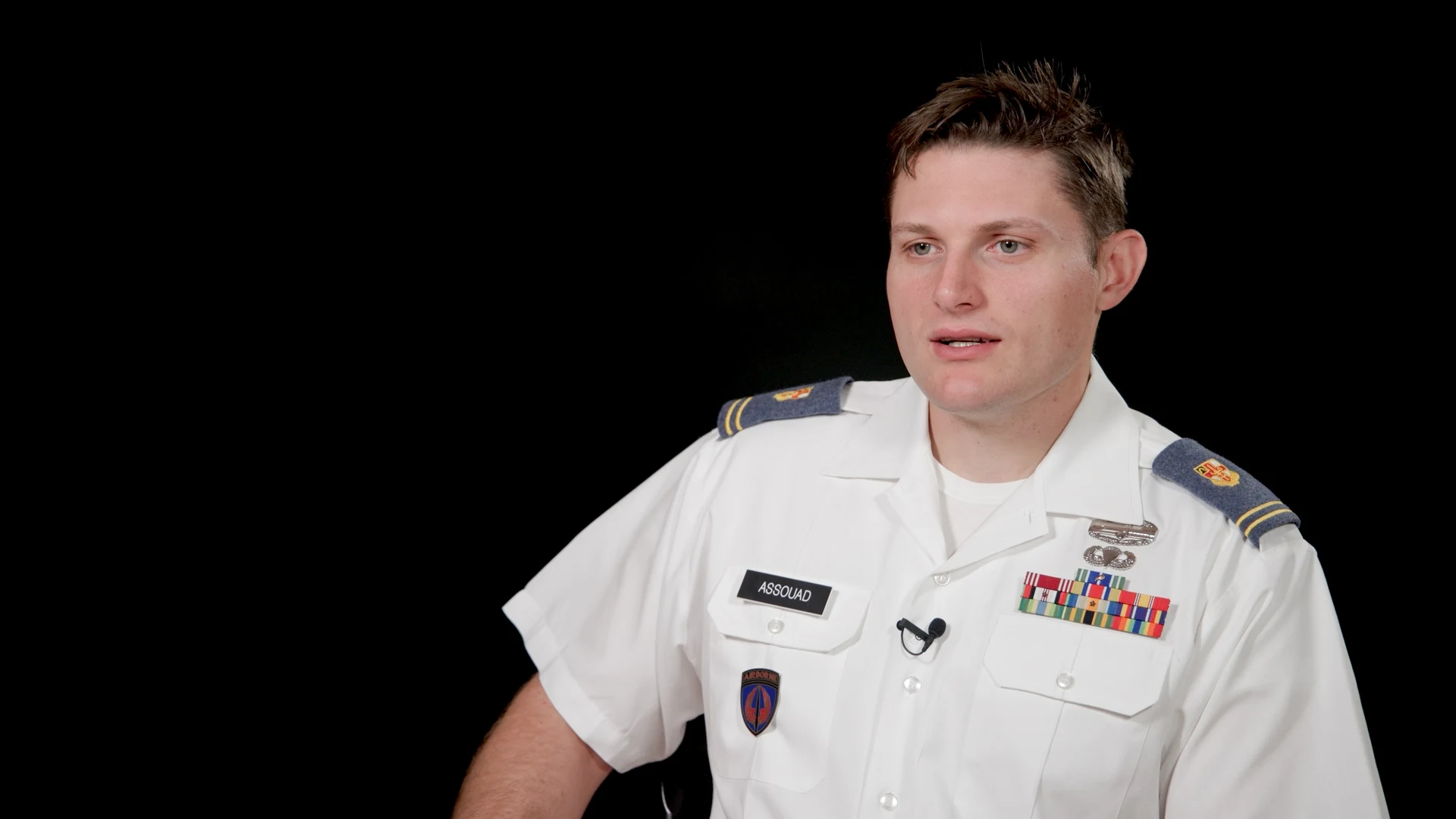
Hometown: Fredericksburg, Virginia
Major: International Studies
Military Service: Enlisted in the U.S. Army in 2016 and served with the Special Operations Aviation Regiment Airborne. Deployed to Afghanistan in 2020 and Iraq in 2021.
Q: How did you find your way to VMI?
A: “What brought me to VMI was I got invited by the previous commandant [Adrian Bogart ’81]. We both served in Afghanistan, so it was kind of a link right there. I’m a bit older, so I had to get a little bit of a waiver. But as a vet, I was kind of linked right there due to VMI’s military heritage, in a way.”
Q: As an older cadet and a veteran, you bring a unique perspective to barracks. How have you used that earned knowledge to help your brother rats?
A: “I kind of became like that older brother figure to my brother rats as they transformed through the Rat Line and stuff like that—just like the little things of teaching how to wear the uniform, stuff like that, because I was a non-commissioned officer in the Army. So teaching soldiers pretty much transfers right over to teaching my brother rats, like, ‘Hey, do this. Don’t do that.’ So it’s good to be that shoulder to lean on.”
Q: What’s been your experience of academics at VMI?
A: “I’ve enjoyed the academics thoroughly, just because I’m learning new things about a broad set of topics. International studies is such an all-encompassing major in regard to international politics, micro, macro politics, stuff like that. I really enjoy it genuinely. And then what comes with that is the language you have to learn. I chose Arabic as my language. … Arabic is a language I’ve fallen in love with, and there’s a billion different dialects, and every letter can be a different letter somewhere else, and it just sounds amazing once you actually get to learn it.”
Q: As a 1st Class cadet and a class officer, you’re a role model for rats. What excites you the most about that?
A: “I’m honestly the most excited about having an incoming mass of rats and being able to mold so many minds. And then, kind of a quote I have since, actually, in my speech I gave when I got elected president was Rat Line, not a frat line. It just means something to me that I’m going to want to train these kids, because my goal for the Rat Line is a 70% commissioning rate.”
Q: A 70% commissioning rate is a very audacious goal. Why is this so important to you?
A: “I think service to the nation is one of the greatest things you can do. There’s a quote from [President] John F. Kennedy: ‘Ask not what your nation can do for you, but what you can do for your nation.’ I think that’s one of the greatest things any American can do, is say, ‘Send me.’ Because why should it be anyone else? If you’re able-bodied, if you can do it. That’s what I did when I was 18. I said, well, there’s a war, send me. And I went twice.”
Q: Why is VMI’s Honor Code so important?
A: “The Honor Code here is definitely something that I wish the rest of the world would subscribe to. The Honor Code teaches that no, this is what we will do, and this is what will happen no matter what. And I think that building block of what it really means to be honorable creates people who will fulfill it.”
Q: What’s your plan for after VMI?
A: “After VMI, I plan on commissioning in the Virginia National Guard and then going to work for the federal government in D.C.”
Editor’s Note: This interview was conducted in spring 2026, at the end of Assouad’s 2nd Class year.
Aiden Psczulkoski ’27, Honor Court President
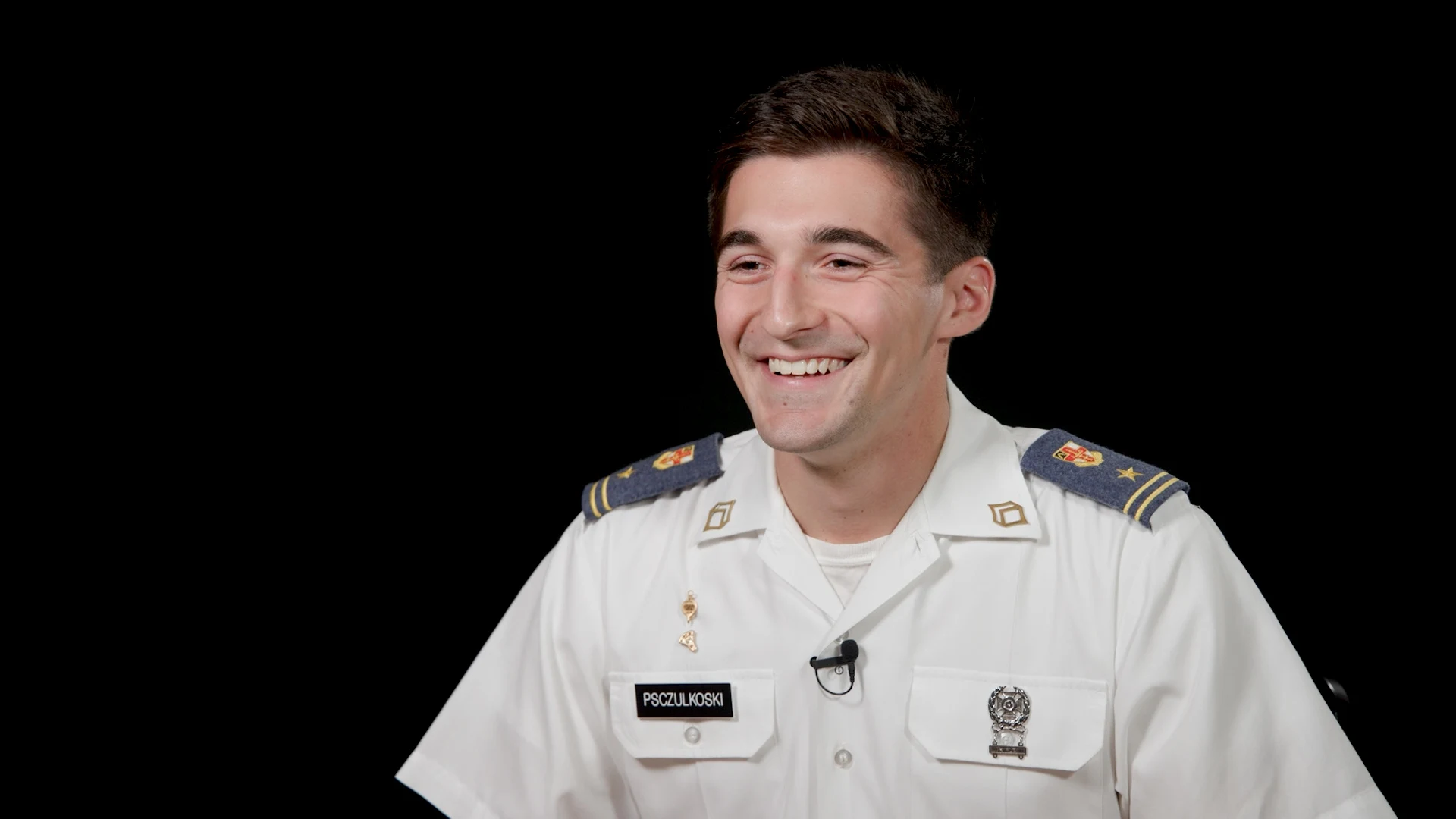
Hometown: Arcanum, Ohio
Double Major: Physics and Applied Mathematics
Commissioning: U.S. Air Force
Involvement on Post: Honor Court president, Institute Honors scholar, and Bravo Company commander
Scholarships: Call to Duty Scholarship, ROTC Scholarship, F.D. Gottwald Scholar Scholarship
Q: What was your path to VMI?
A: “What brought me to VMI was actually my grandfather. He worked at a company run by two VMI alumni themselves, a research and development company called Resonant Sciences in Dayton, Ohio. In my freshman year of high school, they actually all brought me down to VMI to look at it. … When I came here, I fell in love with it. It was something where I really didn’t see myself going to any other school.”
Q: During your cadetship, what challenging days or lessons learned stand out?
A: “There were quite a few of those moments throughout my time, especially my rat year. I fortunately had a very good dyke to help take care of me, talk me away from all those sort of negative thoughts, and keep me focused on what I needed to do, which were my academics, continuing to be a good BR for all my other brother rats, and making sure I was upholding those core values that every VMI cadet has.”
Q: What helped you push through on hard days?
A: “Obviously, my dyke was a great source of support throughout my time here. My family all lives in Ohio, so I didn’t have the super close support a lot of other rats or cadets here do have, because a lot of them do come from Virginia. I also had a magnificent host family. They live right in Lexington. I met them my freshman year when I came down to visit. And then in the physics and math departments, my professors were fantastic pieces of support, as well. I have a lot to attribute to my success here; I had a lot of wonderful people looking out for me and taking care of me throughout my time.”
Q: What has been your experience with the Honor Code as a rat to the present?
A: “The Honor Code was one of the biggest reasons that I came to VMI. It is what sets [VMI] apart from every other college in the United States: How much we preach the Honor Code and the fact that it is single sanction. You know that when you graduate, everybody you’re graduating with took the same path, did it the right way, and did it the right way the first time.”
Q: What was it like being named Honor Court president?
A: “Those first couple of days afterward, you sort of feel the pressure and the gravity of the situation that you’re in. You’re upholding a system that has been an integral part of VMI ever since its founding and really makes VMI what it is.”
Q: What are your goals in this important role?
A: “Education is the cornerstone of what makes our process valid. We have to educate the Corps on the technical things that come with following the honor system, such as your help received statements, signing out on permit forms—all those things that help us uphold the standard. But also, one of the biggest things that we want to preach for the upcoming year is that honor is a lifestyle, and that’s something that I think is incredibly important, especially in the day and age that we’re in where it may not seem like honor is that important. You have social media and a lot of different outlets that show all of these individuals who are gaining a lot of advantage through these sort of dishonorable means. That’s something that we want to establish: That’s not how you do it. There’s a way to do it, and this is how you do it at VMI, but also in your life.”
Q: As a cadet wearing academic stars, what does your education mean to you?
A: “I currently have a cumulative 4.0 GPA in both of my majors, and that’s a testament to prioritization and time management. You learn that very quickly at VMI, or it comes back to bite you. You need to make sure that you do those things, and as you progress throughout your time at VMI, you can really learn and work with your departments and faculty who work with you if you work with them.”
Q: What is next for you after graduation?
A: “I plan on commissioning into the U.S. Air Force as a physicist, and in my first few years, I would like to get my Ph.D. or a master’s in physics and then follow that with service in the Air Force.”
Editor’s Note: This interview was conducted in spring 2026, at the end of Psczulkoski’s 2nd Class year.
-

Mary Price Communications Officer – Features
The communications officer – features leads the creation of compelling, mission-driven written content that often supports fundraising and donor engagement efforts. In addition to crafting development-focused communications, this role contributes to the editorial success of key Alumni Agencies publications through strategic, long-form storytelling and by maintaining close working relationships with volunteer leaders.
Victoria Raff Digital Content Strategist
The digital content strategist is responsible for creating compelling, audience-appropriate, multi-channel content for social media, and for monitoring the VMI Alumni Agencies' social media accounts. The strategist supports all communications efforts, including video editing, website updating, and email marketing deployment and training.