Featured Article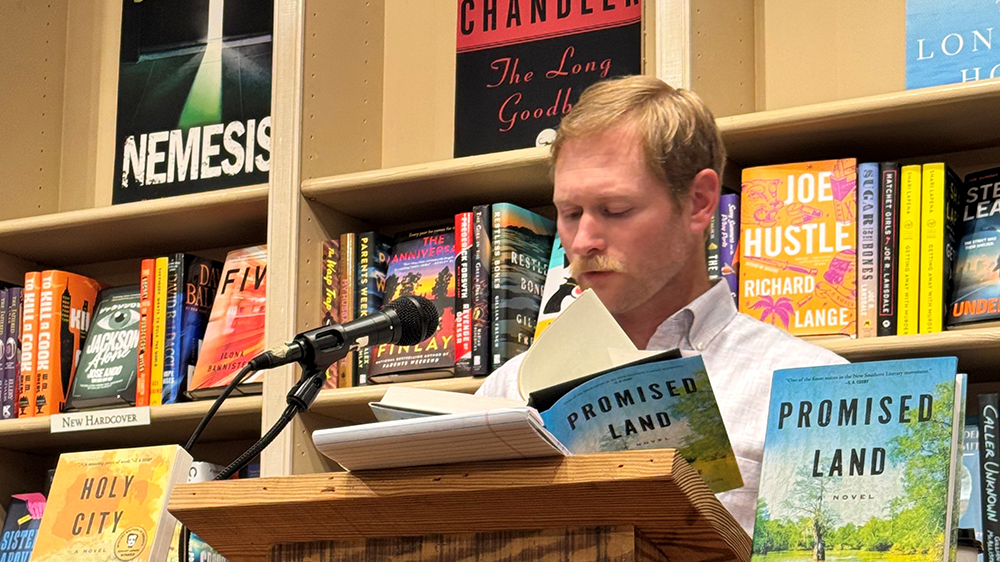
Lt. Col. Henry Wise ’05: Legacy and Literature
Lt. Col. Henry A. Wise III ’05 reads from his newly published novel, "Promised Land" at McIntyre's Bookstore in Pittsboro, North Carolina, in September 2026.
Lt. Col. Henry A. Wise III ’05 reads from his newly published novel, "Promised Land" at McIntyre's Bookstore in Pittsboro, North Carolina, in September 2026.
Born into a multigenerational VMI family and raised in Richmond, Virginia, Lt. Col. Henry A. Wise III ’05 seemed destined for a cadetship since birth. After all, the line of Wises who have come out of VMI starts with John S. Wise, Class of 1866, and stretches all the way into the 21st century.
But the weight of legacy can feel oppressive, especially to the young, and by high school, Wise was torn between his UVA graduate father’s admiration for the Institute and his desire to forge his own path.
“My family was actually almost the reason that I didn’t come,” said Wise, an acclaimed crime fiction novelist, photographer, and poet who’s been a faculty member in the Department of English, Rhetoric, and Humanistic Studies since 2017. “I didn’t want to go somewhere just because my family went somewhere.”
In the end, Wise chose VMI for his own reasons and applied early decision, drawn by the vaunted Honor Code and the desire to challenge himself. “I wanted to see if I could do it,” he stated.
By his own admission, Wise’s cadetship was not a model worthy of emulation, and when asked to recount memories of his years in barracks, penalty tours came to mind most readily. With a fondness for running the block, he found himself on confinement, marching back and forth in front of barracks, quite often.
Academically, though, Wise was much less rebellious, soaking up chances to learn from faculty members like Col. Rob McDonald, Ph.D., and the poet R.T. “Rod” Smith, longtime editor of Washington and Lee University’s noted literary magazine, Shenandoah, which has published such renowned authors as ee cummings and Tom Wolfe.
Although Smith taught at VMI for only 1 semester, his influence on Wise was tremendous, and he unlocked a door Wise had scarcely thought would open. Already an aspiring writer by the time he matriculated, Wise found his voice in Smith’s classroom and was elated to see two of his poems selected for publication in Shenandoah shortly after graduation.
“That semester is probably responsible for my career as a writer,” said Wise. “When you’re writing on your own, you don’t know what’s good and what’s not. You feel that certain things are good, but you don’t really know. … That kind of blessing from him made me realize that I had something.”
Graduating from VMI with a Bachelor of Arts degree in English, Wise took the opportunity to immerse himself in another culture by teaching English at the ROC Military Academy in Taiwan for 4 years.
He then returned to the United States, where he earned a Master of Fine Arts degree from the University of Mississippi. Family connections and full funding for graduate study were a big draw—but so was the luminous, lingering aura of the legendary Southern writer William Faulkner, whom Wise had admired ever since high school, when his father gave him a copy of Faulkner’s novella “The Bear” as a Christmas present.
“Faulkner really spoke to me because he was so clearly grappling with the complex identity of being Southern, and my family goes way back in Virginia,” Wise noted.
After 5 years in Mississippi, Wise and his wife, Jessica, were eager to return to Virginia, so when an opportunity to teach at VMI opened up, the couple returned to their roots. Since then, Wise has been delving into all the opportunities and challenges teaching and writing present. In the past 5 years, he’s become a father twice, published two books—“Holy City” in 2024 and “Promised Land” in 2026—and taught many cadets. This year, he’s been on numerous book tours promoting his latest novel while hard at work finishing a third, and his success as a novelist was recently highlighted in Virginia Living magazine.
“At the academies, there’s one goal: Make you an officer. Here at VMI, you’re prepared to be an officer, but you’re also prepared to do other things. The citizen-soldier model is very unique.”
Lt. Col. Henry A. Wise III ’05
Both books have met with immediate critical acclaim: “Holy City” won the 2025 Edgar Award for Best First Novel from the Mystery Writers of America, and Kirkus Reviews described the book as the work of “a new master of Southern gothic.”
“Promised Land,” which was just released this fall, has likewise garnered accolades, with Kirkus Reviews noting, “With his two novels, Wise has leaped to the forefront of recharging and reshaping Southern fiction. A bravura and sometimes brutal novel about our efforts to cope with darkness and denial.”
On post, Wise is currently teaching three classes: Writing & Rhetoric I (a required class for rats), Genre Studies: Poetry, and American Literary Traditions.
As a working writer, Wise knows the visceral struggle of getting words onto paper, or onto a computer screen, and he brings that awareness into his classes. “I think it’s a real strength to be able to say, ‘Look, I’m not just telling you to face the blank page. I’m actually doing it, too,” he commented.
With vivid memories of his own years in barracks, Wise knows just how busy a cadet’s day can be, and how hard it is to squeeze in any kind of creative output.
“Because I was eking out [my writing] paragraph by paragraph, verse by verse, in those between moments at VMI, my writing definitely does inform my teaching because it contributes to my ethos with the cadets,” he stated. “I’m drawing on the skills and determination I learned as a cadet.”
Teaching at VMI, he related, is his way of giving back to an institution that has given him and his family so much. “I think of it as a kind of service because I really do believe that this is the most unique education, and also one of the most consequential,” he said. “People who come here, maybe not all of them, but many of them will become leaders in our country, and I think we need that more than ever. And you know, VMI has always outpunched its size.”
Outside the classroom, Wise serves as faculty advisor to Cadence, VMI’s literary magazine—an appropriate undertaking because he edited that publication, then known as Sounding Brass, as a 1st Class cadet. Happily, Wise noted, cadet interest in creative writing and visual art has expanded significantly since his cadetship, and the creative arts play a vital role at a military school, even though their function isn’t obvious.
“We have a very good problem, which is that we receive way too much to put in the journal,” said Wise.
“It’s just opened my eyes to how useful the creative arts are even in a place like VMI,” he continued. “During COVID, I thought it was very likely that we were not going to be able to put out a journal. Up until that point, I think we had never received more submissions than we did in that year, and that just showed me that, especially in hard times, it wasn’t trivial for people. It was actually a real outlet.”
The Institute has never been known as a school for the arts, but that doesn’t stop Wise from making a bold statement: “There’s more creativity at VMI than anywhere else in the world.” In his Virginia Living interview, Wise elaborated on this, saying, “In some ways [VMI is] the best place to get interested in writing because you see a lot of people under pressure all the time, and you see life isn’t all that interesting when everybody’s got it together. At VMI, you’re sleep-deprived, you’re busy, you’ve got all this stuff to do, and there’s no hiding. People’s characteristics come out.”
Wise noted that writing in general, and the VMI English major in particular, fed his need for creative expression during his cadetship.
“Writing was a way of balancing the structure of VMI for me,” he stated. “That’s why I loved the English major so much. It encouraged that kind of thought that I think made the military side of things more exciting and more meaningful.”
Wise noted that ever since its inception, VMI has been a liberal arts college. “That’s one of the things that makes it unique,” he said. “At the academies, there’s one goal: Make you an officer. Here at VMI, you’re prepared to be an officer, but you’re also prepared to do other things. The citizen-soldier model is very unique.”
Col. Emily Miller, Ph.D., English department head, noted that Wise brings a unique set of strengths.
“When an alumnus speaks with cadets about a passion for writing, most listen,” she said. “When that alumnus is also an award-winning novelist, at a young age, they are even more attentive. With his talents as a poet, novelist, essayist, and teacher, Henry Wise has inspired a number of cadets to enjoy literature and write creatively themselves. With Henry as their mentor, some have even written novels. Many have submitted to the VMI creative arts journal, Cadence, as well. We are very fortunate to have an alumnus of his caliber on the VMI faculty.”

The communications officer – features leads the creation of compelling, mission-driven written content that often supports fundraising and donor engagement efforts. In addition to crafting development-focused communications, this role contributes to the editorial success of key Alumni Agencies publications through strategic, long-form storytelling and by maintaining close working relationships with volunteer leaders.