Featured Article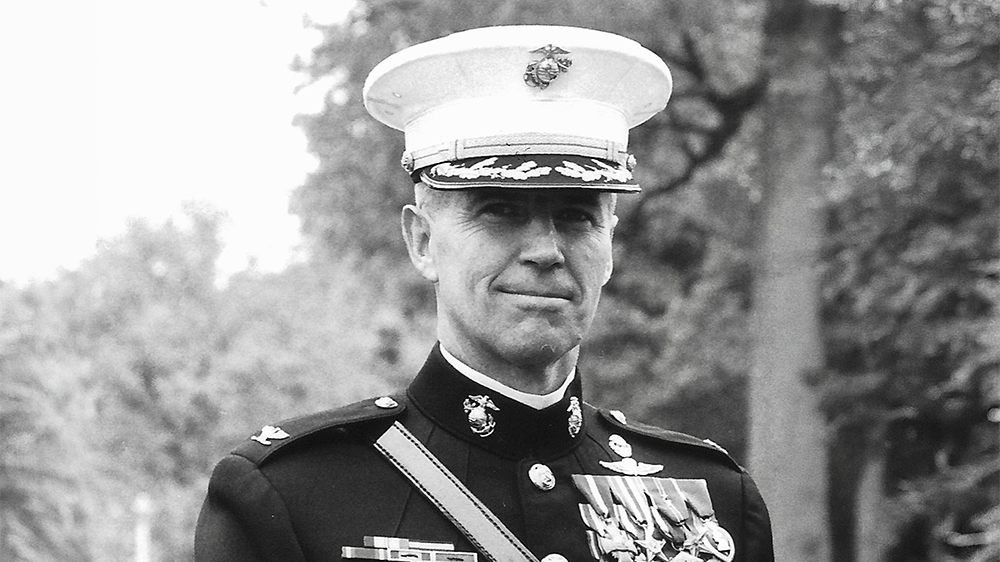
The Ripley Family: Lives of Leadership and Honor
U.S. Marine Corps Col. John Ripley during his time as commander of VMI’s Naval ROTC unit.—Photos courtesy Tom Ripley ’93.
U.S. Marine Corps Col. John Ripley during his time as commander of VMI’s Naval ROTC unit.—Photos courtesy Tom Ripley ’93.
For 78 years, the name “Ripley” has echoed across the VMI post. Borne by three generations of alumni and a war hero non-alumnus who served as head of VMI’s Naval ROTC unit in the 1990s, those bearing that name have represented the Institute with dedication both on the battlefield and in the boardroom. Earlier this year, the name was even at the top of the day’s agenda in the White House and at the Pentagon, where separate ceremonies were held marking a milestone achievement.
On Thursday, June 18, 2026, Tom Ripley ’93 and his brother, John M. Ripley ’96, traveled to Washington, D.C., to attend a historic event 54 years in the making: The posthumous presentation of the Congressional Medal of Honor, the nation’s highest military award, to their father, retired U.S. Marine Corps Col. John W. Ripley. The White House ceremony, during which President Donald Trump presented the award to the Ripley brothers and other members of their family, marked a high point for a longtime VMI family dedicated to lives of leadership and honor.
A 1962 graduate of the U.S. Naval Academy who died in 2008, the elder John Ripley at first earned the Navy Cross for his heroic actions in Vietnam on Easter Sunday 1972. On his second tour of duty in that nation, John was serving as an adviser with the Third Vietnamese Marine Corps Infantry Battalion, which he described in a 1986 interview with Leatherneck magazine as “one of the best doggone units,” when he learned that 200 tanks from the North Vietnamese Army were advancing toward the Dong Ha bridge nearby. That Sunday morning, John saw a North Vietnamese flag flying on the opposite shore of the river, meaning troops were poised to cross at any moment.
Destroying the bridge was the only way to halt the enemy advance, but so far, the efforts to install explosives by the South Vietnamese forces John was leading had been ineffectual. The job needed to get done—and fast. With the swirling waters of the Cua Viet River below him, and with enemy fire emanating from the North Vietnamese across the river, John partnered with a U.S. Army officer, Maj. James Smock, to work underneath the bridge, swinging from I-beam to I-beam, to position approximately 500 pounds of TNT.
“I would hand-walk out, then swing up to get my heels into the I -beam,” John recounted to Leatherneck magazine. “Then I’d swing down on one T-beam and then leap over and grab another T-beam.” After 5 hours of grueling effort, John detonated the explosives, and the bridge collapsed, stymying the North Vietnamese advance. At the June Pentagon ceremony, Tom recounted the iconic “SITREP” his father offered to his commanding officer a few days later: “Leatherneck, this is Leatherneck Delta. Report: Powder dry. Morale high. Semper Fi.”
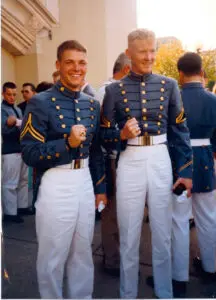
Tom Ripley ’93, and Bill Butler ’93, Tom’s roommate, at Ring Figure in fall 1991.
The Ripley family’s VMI story likewise represents a long span of time, beginning when retired U.S. Marine Corps Col. George H. Ripley ’52 matriculated from Radford, Virginia, in 1948. The Ripleys were a “typical Southwest Virginia family,” Tom recounted, and George and John Ripley’s father had a good job for that era, running the Radford interchange for what was then the Norfolk & Western Railroad.
A standout cadet-athlete who played nose tackle on the Keydet football team that defeated Georgia Tech, George earned a Bachelor of Science degree in electrical engineering and commissioned into the Marines. In 1974, George returned to post as the first commanding officer of the newly established Naval ROTC unit, and he later served as the Institute’s deputy superintendent.
As a young boy, Tom would often be sent to Lexington to spend summers with his Uncle George, thus providing him with his first exposure to VMI. “We’d go fishing, or to the rope swing, and so when I was 8, 9 years old, he was in Lexington, Virginia, I’d go down there and stay for a couple of weeks with him,” Tom recalled.
By the time graduation from Camp Lejeune High School rolled around, Tom had set his sights on the Institute. “Uncle George was always a person I admired,” he noted. “We looked a lot alike, and I had spent my summers at VMI, and so it just felt like a great fit for me.”
As he began his 3rd Class year, Tom received surprising news: His father had been appointed commanding officer of VMI’s Naval ROTC unit, following in his older brother, George’s, footsteps. Tom was enrolled in Naval ROTC at the time, and having his father as his commanding officer was a unique situation. While some sons would have struggled with even the thought of following in the footsteps of such a living legend, Tom took advantage of it as an immense learning opportunity. “I was really blessed to have a mentor, a person I could call with a problem, an issue I was struggling with, or a decision I had to make, and so we talked about leadership and the Marine Corps,” he stated. “It came up all the time.”
Graduating from the Institute with a Bachelor of Arts degree in history, Tom followed his family’s path to national service and commissioned into the Marine Corps, where he served for 5 years. “I had a wonderful time, great [commanding officers], great experiences, lots of deployments,” he stated. “But I had spent all my childhood on Marine bases and around the Marine Corps. I loved my time, but I also knew I wanted to see what else was out there.”
His next step was the University of Chicago’s MBA program—one of the most highly prestigious business schools in the nation. Time on Wall Street followed, in the rarefied air of Bear Stearns and Goldman Sachs, two of the country’s most well-known investment banks. Shortly after, he transitioned into private equity. That transition wasn’t a resounding success—at least at first. “When you’re young like that, the good news is you have a lot of resilience and ability to learn from your mistakes,” he said. “I made a lot of them in those first couple of years. … It wasn’t until my third investment that things really began to take off.”
Since 2015, Tom has helmed his own firm, Ames Watson, and the company, which brings in more than $4 billion in revenue each year, includes marquee retail names like Claire’s, Champion Teamwear, Lids, South Moon Under, and more. Just maintaining standing in retail is challenging enough—staying ahead of the curve even more so. Today, Tom credits the lessons he learned on post for the discipline and focus it takes to keep his company competitive.
As a member of the Keydet lacrosse team, Tom learned from the beginning of his cadetship that time management is key. “At VMI, there’s never enough time to do other things you have to do,” he said. “That’s frankly by design. … You are chronically deciding between what you’re going to have to not do to finish some other priority.”
In the business world, that translates into balancing seemingly impossible competing demands. “You never have enough resources,” he commented. “The types of businesses I buy are usually distressed in some form, and so you’re constantly trying to balance the various demands you have. Triaging between one item and another is what leaders do, and so that is a lesson that frankly was really kind of ingrained in me early on in VMI and honed over my 4 years there.”
“VMI gave me way more than I could ever give it.”
Tom Ripley ’93
Academics, too, were instrumental to Tom’s formation, and Tom remembers two professors in particular: U.S. Navy Capt. Blair Turner, Ph.D., and D. Clayton James, Ph.D. Faculty members like Turner and James, he avows, laid the groundwork for future endeavors. “It’s not what you learn; it’s understanding how to learn,” he said. “It’s understanding how to think critically, how to make your case, defend your position.”
Undergirding everything on post, of course, is the Rat Line and the honor system. “I think the VMI honor system and the Rat Line are two sides of the same coin,” Tom observed. “They both require and demand a young [person] at a very early age to both embrace discipline at a level that society doesn’t teach anymore, but also to understand how to deal with absolutes. The VMI honor system and the Rat Line are both environments that are absolute in their outcomes—that there is right and there is wrong.”
Four years immersed in those precepts, Tom believes, is a set-up for success in any field. “That’s a skill set that transfers incredibly well to the military in a life-and-death environment and to any business. Business is finite: The outcomes are absolute, and you’re either successful or you’re not. VMI clarifies your thinking on things.”
VMI also taught Tom the importance of taking each day as it comes, always with a forward-looking mindset. “All the businesses I buy come with a certain level of stress, but every day I wake up, I get my workout in, I start my day fresh, and I can attack today being able to compartmentalize the difficulties of yesterday,” he noted. “That lesson I learned at VMI.”
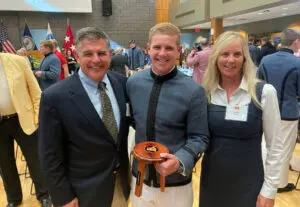
Scout Ripley ’23 receives the Three-Legged Stool Award, the VMI Keydet Club’s highest honor for a cadet-athlete, at the Keydet Club Scholarship Banquet in spring 2023. Scout, who was captain of VMI’s NCAA lacrosse team during his 1st Class year, is pictured with his parents, Stephen and Lynne Ripley.
Scout earned the Keydet Club’s Three-Legged Stool Award in 2023 for his excellence in the academic, athletic, and military domains that make up the VMI experience. A distinguished graduate of VMI with a double major in history and English, Scout is now attending law school at the University of Richmond with the goal of becoming a JAG officer in the Marine Corps.
“Both Matt and Scout are easily the most successful cadets in the Ripley family,” Tom observed. “My brother, John, and I excelled athletically, but we set easily ‘achievable’ bars for them in academics and conduct. Scout, in particular, wore academic stars his entire time at VMI, and he was a wonderful lacrosse player, captain of the lacrosse team like my brother, John, was previously, and a great contributor early on.”
Right away, Tom could see that his nephew had a common experience on post as he and John had decades earlier—forming lifetime bonds with brother rats. “One of the most special parts about Scout’s VMI experience is the relationships that he has with his class are exactly the same that we had,” he commented.
A number of brother rats and VMI alumni from the younger Ripley brothers’ time attended the White House ceremony, and with the younger John in the same dyke line, alumni from the Classes of 1990, 1993, and 1996 were all present, including U.S. Air Force Gen. Dan Caine ’90, chairman of the Joint Chiefs of Staff; Mike Waltz ’96, U.S. ambassador to the United Nations; and Mike Obadal ’96, undersecretary of the Army. Among the distinguished guests attending the ceremony was Ripley’s dyke, U.S. Marine Corps Maj. Gen. William “Bill” Bowers ’90.
“My class graduated 247 guys,” Tom said. “To have that continuity 30 years later is remarkable, and to see men from my time at VMI currently serving in high-level political and military positions makes you proud.”
While feeling a great pride in both his father’s actions and the strength of the bonds that unite the VMI family, Tom is careful to stress that the Medal of Honor isn’t just about one man’s valiant efforts. The elder John and his wife, the late Moline Ripley, were a powerful team, Tom noted, and she was an anchor holding the family together. At the time of John’s second deployment to Vietnam, she was home in Blacksburg, Virginia, with three children under the age of 7. “Next to every great man [or woman] is a spouse that expects nothing less,” said Tom. “She was the driving force behind my father’s success.”
As his father did during his lifetime, Tom also credits the individuals, both Vietnamese and American, who served with John in Vietnam. “Anytime my father would speak about the actions around Easter Sunday, he would always talk about the men who served with him,” Tom said. “Medals and awards are never about one individual. They’re given to individuals, but anything great that has ever been accomplished has always been accomplished by the team.”
Today, 18 years after his father’s death, Tom is still learning just how many lives his father touched, especially at VMI, and a number of previously untold stories have come to light since the June ceremonies. “I’ve heard from dozens of guys 2 or 3 years ahead of me who were commissioned by my father and had incredible things to say about his impact on them,” Tom stated. “One of the best parts of this experience has been hearing little vignettes and reliving parts of my dad’s history through those emails and phone calls.”
With deep appreciation for all that VMI has done for him and his family, and in grateful acknowledgment of the two scholarships he received from the Institute, Tom makes supporting VMI a high philanthropic priority. “VMI gave me way more than I could ever give it,” he stated. “I don’t think that’s something I realized when I graduated, but when I look back, all the decisions I make now in my life are all rooted in discipline and integrity, and the tenets of my experience at VMI. … In order for any school to continue, it has to be supported by its alumni. … I am proud to support such a great school, and I feel obligated to support the future of VMI—a place that gave me so much.”

The communications officer – features leads the creation of compelling, mission-driven written content that often supports fundraising and donor engagement efforts. In addition to crafting development-focused communications, this role contributes to the editorial success of key Alumni Agencies publications through strategic, long-form storytelling and by maintaining close working relationships with volunteer leaders.