Featured Article
Williams Receives DSA | Distinguished Service Award Resolution | Q&A | Photos
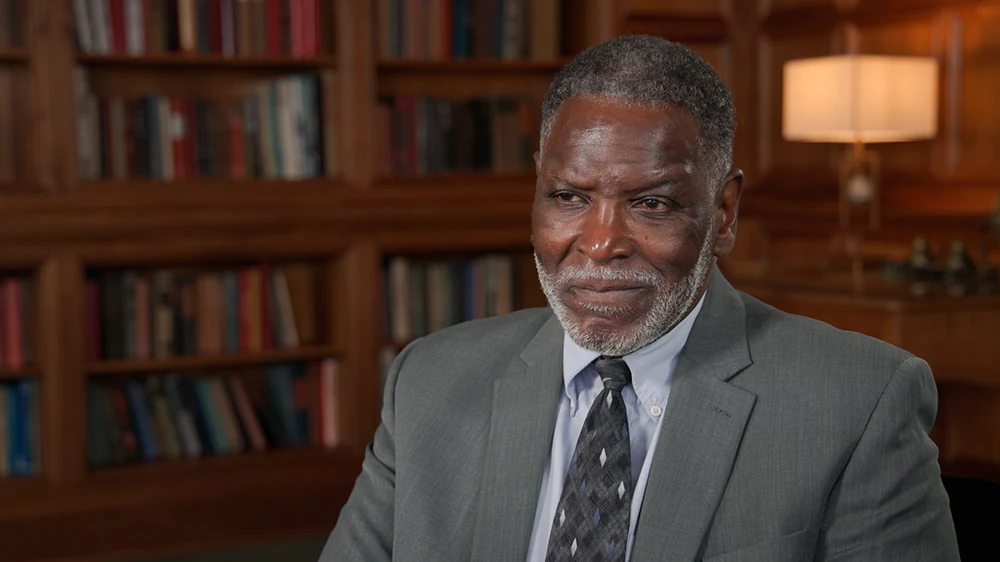
Eugene “Gene” Williams ’74, former VMI Board of Visitors member and founder and executive director of the College Orientation Workshop, received the VMI Foundation Distinguished Service Award during the Founders Day Convocation at Cameron Hall Nov. 7, 2025. John P. Williams ’88, VMI Foundation president and VMI Alumni Agencies Board chairman, presented the award.
The VMI Foundation Board of Trustees granted the award to Williams primarily in recognition of his long and distinguished record of service to the communities in which he has lived and worked through numerous charitable organizations, the VMI family, and hundreds of young men through COW.
In 1978, Williams started his service to VMI as the youngest member of the Board of Visitors, where he served for a decade. He was a VMI Foundation trustee from 1996–97 and on the VMI Keydet Club Board of Governors from 1989–92.
Williams is best known for his establishment of COW in the mid-1980s—and his continued hands-on leadership of that program. With a mission “to enrich the lives of deserving young people who are most at risk of failing to achieve their full God-given potential,” COW brings dozens of young men to VMI each summer to give them the skills they need to succeed and to inspire them to set and pursue ambitious goals.
Prior to presenting the DSA, John described Williams as “someone exceptional—a servant-leader and steadfast exemplar of VMI’s highest ideals.
“Gene’s story is rooted in habits familiar to every cadet: Early formations, squared corners, and the quiet grind of doing one more rep, one more page, one more mile. What sets him apart is not the absence of obstacles but the character with which he met them. Throughout his career, he chose service over spotlight and impact over credit.”
He also highlighted Williams’ devotion to COW. “The program’s success rests on many factors, but, above all, on Gene’s unwavering insistence on effort, integrity, and high standards—qualities he exemplifies every day.”
John reminded cadets that the DSA is focused on “sustained, selfless service—service that holds itself to a standard even when no one is watching.” He urged them to listen closely to Williams and “find something that you can take away for your own betterment. I’m confident there will be something in there for each of you.”
In his remarks, Williams thanked many people, from his family and his brother rats to members of the Institute’s faculty and staff and many alumni for the support they provided him as a cadet and afterward. He also expressed his gratitude to “my brother rats and my VMI-connected brothers from other mothers for … being foundations and guardrails for my life. Were it not for you, I would not have any friends or a best man at my wedding, and my son would not have any godfathers.” He told the cadets, “In the not-too-distant future, you … will know of what I speak when I tell you that the bonds of VMI are strong and extend across all boundaries, be they race, religion, class, gender, geography, or time.
“I am grateful and humbled for this honor,” he continued. “I am a bit embarrassed about it all because I know there is so much more I can and should be doing, and there are others who are equally deserving of this.
“There are many elements that contribute to the greatness of the VMI experience, and there is so much that I love about the principles and ideals associated with this unique and indispensable institution, including its ability to draw out the very best in emerging young leaders ... and its record of tremendous contributions to our country and the world.”
Eugene Williams '74 VMI Foundation Distinguished Service Award recipient
“My heart is full because I love my school [and] the principles upon which it operates, as best I understand them; many of the people I have encountered here; and what my VMI experience—warts, bruises, and all—has meant to me. I have spent my entire adult life connected with and committed to my school with all my heart and soul. I have been rewarded in manifold ways from my association with the Institute. I count myself truly blessed to be of VMI.
“There are many elements that contribute to the greatness of the VMI experience, and there is so much that I love about the principles and ideals associated with this unique and indispensable institution, including its ability to draw out the very best in emerging young leaders … and its record of tremendous contributions to our country and the world. I believe that those of us who have been fortunate enough to experience and survive VMI are truly blessed.”
Williams did state he regretted VMI was the last public institution in Virginia to adopt racial integration. But VMI “implemented the integration of the Corps with dignity, fairness, and a determination that failure was not an option. … [N]o other school in … Virginia or, dare I say, the country, integrated … more smoothly, fairly, and successfully than did VMI. It repeated that performance in 1997 with the admission of women. Neither of these … were flawless … but we did demonstrate that we could do very well whatever we resolved to do.”
Williams also charged cadets to take responsibility for the country’s future. “We need more young people like you outstanding cadets to help make America and the world truly great. I know that you have the intellect, the backbone, and the strength of character to do this. It is going to take tremendous courage and foresight on your part and the support of the leaders here at VMI to make that a continuing reality.”
His confidence that today’s Corps can be exemplary leaders stems from his own experience. “In many ways, I am actually defined by my school. VMI molded my life into something of value.” While he probably would have done fine had he attended another school, “I would not have been the same. The unique qualities of the people I have met, the growth-triggering challenges I have been offered and endured, and the opportunities to impact lives I have had at VMI have been incomparable.”
Williams explained that his decades-long commitment to COW is rooted in the VMI experience’s enduring value. “VMI is a great school with a great history. It has … produced extraordinary [graduates], like George C. Marshall, Class of 1901; Jonathan Daniels ’61; and Herbert Dillard, Class of 1934. … It continues to be a transformational training ground for outstanding young people.
“We don’t have a monopoly on all that is great,” he continued. “However, I do believe we have more than our fair share of greatness among us. That being the case … we have an added responsibility and wonderful opportunity to pay forward some of the great blessings that have been bestowed upon us.”
He described COW’s purpose as to expose “deserving young people, who have far too many unearned challenges, to the hard and valuable lessons of the VMI educational and developmental model. For the past 40 years, we have operated COW … to change lives and create possibilities for generational transformations. We have exported the values and principles of VMI to communities across every region of this country.”
He closed his remarks by saying, “I have always had confidence that the leaders of VMI were committed to developing healthy and honorable young leaders and having fidelity to the principles of this outstanding institution. I have faith that this will continue to be the case.”
Williams ’74 Distinguished Service Award Resolution
WHEREAS, Mr. Eugene Williams, Class of 1974, exemplified the ideals of the Virginia Military Institute through his academic excellence as a mathematics major, his leadership as a cadet lieutenant, and his athletic achievements as a standout football player; and
WHEREAS, following his graduation, Mr. Williams commenced a distinguished 38-year career with C&P Telephone, a predecessor of Verizon Communications, where he held positions of increasing responsibility and played a pivotal role in the restoration of communications services in New York City following the terrorist attacks of September 11, 2001; and
WHEREAS, Mr. Williams has demonstrated a lifelong commitment to service through his involvement with numerous charitable organizations across the nation; and
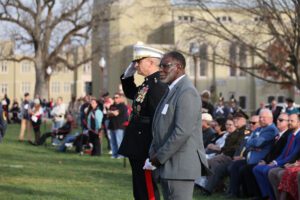
Williams takes review of the Founders Day Parade with Lt. Gen. David Furness ’87, superintendent.
WHEREAS, in 1987, Mr. Williams founded the College Orientation Workshop with the mission to enrich the lives of deserving young people who are most at risk of failing to achieve their full God-given potential, thereby inspiring hundreds of young men to set ambitious goals and pursue them with determination, while also providing VMI cadets with valuable leadership and mentoring experience; and
WHEREAS, Mr. Williams began his service to the Institute as the youngest member of the Board of Visitors in 1978, serving for a decade, and continued his leadership as a trustee of the VMI Foundation from 1996 to 1997, a member of the VMI Keydet Club’s Board of Governors from 1989 to 1992, and as a leader of the Class of 1974’s 50th Reunion Campaign Committee; and
WHEREAS, Mr. Williams has earned the respect and admiration of his colleagues for his wisdom, integrity, and unwavering dedication to the mission and values of the Virginia Military Institute; and
WHEREAS, his professional accomplishments and steadfast devotion to serving others have significantly enhanced the reputation of the Institute as a school of leadership and his service to VMI has contributed meaningfully to its advancement;
NOW, THEREFORE, BE IT RESOLVED, that the Board of Trustees of the VMI Foundation does hereby recognize and honor Eugene Williams for his many accomplishments, his exemplary commitment to service, and his enduring contributions to the Virginia Military Institute; and
BE IT FURTHER RESOLVED, that the VMI Foundation Board of Trustees proudly presents Eugene Williams with its highest honor, the Distinguished Service Award, as a testament to his legacy of leadership, mentorship, and service.
Q&A With Williams ’74
Q: First, congratulations on receiving the Distinguished Service Award. What was your reaction when you were told you had received the award?
A: My initial reaction when Ernesto Sampson ’98, former Foundation Board of Trustees president, called me was genuine surprise. Honestly, I contemplated not accepting it because doing what you love and feel compelled to do doesn’t require recognition. Furthermore, so many others have contributed greatly to whatever I have achieved at VMI, and it didn’t seem fair to take all the credit. Overall, however, I feel blessed beyond words to receive this recognition.
Q: Why did you decide to attend VMI?
A: Early in my high school career, I decided to attend a military college. I wanted to pursue a path less traveled and seek an environment with rigor and discipline and fewer distractions.
Being reserved by nature and from an economically challenged background, I realized I needed to attend a college where structure and stability were fundamental. I did not want to be in an environment where I’d feel pressure to “keep up with the Joneses” or pursue the latest fashions or trends.
I received an appointment to West Point and planned to attend there—that is, until I visited VMI in the spring. I was mesmerized by the surrounding countryside’s beauty and the genuine kindness of the people at VMI. I was also talked out of attending West Point by Chris Hanburger, who played linebacker for the Washington Redskins. He was a friend of Dave Braine, the assistant coach who was recruiting me for VMI. I suspect that Coach Braine believed an all-star professional football player would have a significant influence on me. And he was right!
Q: Many alumni say that they learned a lot at VMI outside of the classroom. If you agree, what lessons did you learn?
A: I absolutely agree! Living in close quarters and sharing the trials and tribulations of cadet life with people has a big impact. For example, despite the wide variety of socioeconomic backgrounds among cadets, the stress and demands of VMI applied equally, and success or failure was achieved based on the strength of your efforts and grit.
Since most things at VMI are challenging, I learned to believe that I can make it through whatever is thrown at me. This was reinforced time and again on the football field. Our team was always outmanned, and our opponents more rested and probably better fed. We lost many games, but our opponents paid a price. What I frequently saw in action repeatedly was the truth of the saying, “It is not the size of the dog in the fight, but the size of the fight in the dog that matters.”
With all the rules at VMI, including the Honor Code, you learn the true essence of self-discipline and decision-making based on the value proposition of the available choices. I think that this is why VMI graduates and alumni are more accountable and courageous in their actions than the norm.
Q: Wherever your career took you, you made a point of serving others. What inspired you to devote yourself to such service?
A: It is my fundamental belief that we should all work to help make the world better than we found it. For me, this is best done by helping others develop a sense of purpose and aspire to a productive future. I especially want to do this for young people, particularly those who risk not fulfilling their full potential. I am simply paying forward what scores of heaven-inspired people have done for me and doing what my creator expects of me.
Q: You established the College Orientation Workshop in 1987 to help young men “achieve their full God-given potential.” What motivated you to create this organization?
A: As a cadet, I appreciated the value of the VMI educational and developmental approach and wished to share that with more young guys like myself.
As far back as my rat year, I dreamt of a summer program with the best elements of the VMI experience … for those guys who had the potential to be successful in college but who were also at risk of going down a path of underachievement or worse.
There were several programs, such as Upward Bound, that focused on the best and brightest. I saw a pressing need to develop the talents of those in the middle or below it and help them realize their potential.
Over the years, I discussed the idea with Dr. Clark King, who shared my belief that there was a great reservoir of God-given talent in minority and underserved communities that was going to waste. I had similar discussions with Tom Wright ’54, who committed himself passionately to helping me achieve my dream. Without them, COW would never have become real.
Q: In 2026, COW will celebrate its 40th anniversary. What accomplishments of the program give you the most satisfaction?
A: What gives me the most satisfaction is the number of COW graduates who tell us that, prior to attending COW, they didn’t see themselves as college material or realize they could master their fears. While most went on to attend other colleges, such as Judge Marvin Adames, some matriculated at VMI. Among them are U.S. Army Brig. Gen. Kendall Clarke ’95, U.S. Air Force Col. Damian Wilborne ’95, U.S. Navy Cmdr. Richard Borden ’93, and entrepreneur Jamel Lynch ’94.
I take great satisfaction in that COW has significantly benefited decent, at-risk young men who … met the challenge, grew from a character and leadership perspective, and now are responsible and dependable members of their families and communities.
Q: Let’s talk about your time serving VMI. How did you react when you were appointed to the VMI Board of Visitors in 1978, when you were in your 20s? What did you like about your BOV service?
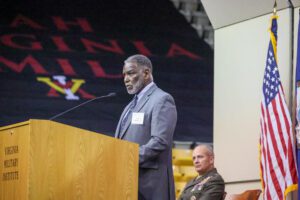
Williams speaks to VMI cadets, faculty, and guests at Founders Day Convocation in Cameron Hall Nov. 7, 2025.
A: Frankly, when the secretary in my office told me that Gov. John Dalton’s office had called, I first thought it was a practical joke.
I have received many undeserved blessings throughout my life. Being appointed to the BOV only a few years after graduation was one of them.
Frank Louthan ’41 was the first BOV president during my tenure. He was the perfect example I needed at that stage of my professional development. By closely watching and listening to him, I learned so much about effective leadership. I learned a great deal from Jack Marsh (Hon) and Frank Liddell ’49B, too.
Throughout my 10-year tenure, I noticed a common trait in the most effective members of the board: They listened more than they spoke, but when they did speak, it was not to play to an audience but to move the debate forward to a decision. Over time, I grew beyond my inhibitions and insecurities, encouraged as I was by so many powerful, successful, and influential people. I soon began to feel that I brought value to our work and that my colleagues listened to me.
My BOV service accelerated my leadership development and my character enhancement. My decisions were better because I had seen firsthand how prominent business executives and retired flag officers asked questions, discussed issues, and made decisions. I also learned to deal with confrontation and uncomfortable subjects and situations more effectively.
It also enhanced my courage to stand alone because there were occasions when that happened. … It is important to note, however, that throughout that matter, my colleagues listened to me closely and with unwavering respect.
Q: If an alumnus were to ask you why he or she should serve VMI and/or financially support it, how would you respond?
A: I would definitely encourage them to share their time, talents, and treasure with VMI. There are some tremendous faculty and staff members who enrich the lives of the exceptional young people in the Corps of Cadets. There are many deserving young people who need the “sharpening” that VMI’s educational system provides. I hope that as many alumni and friends as possible, therefore, choose to advocate for and support this unique and indispensable institution.
Right now, that message might be a hard sell for many alumni. I know that some loyal alumni feel somewhat estranged from VMI because the actions and words of a few haven’t reflected its tradition of fairness and civility. Some recent actions, like those related to the treatment of former superintendent Maj. Gen. Cedric Wins ’85, also have alienated some.
That said, I focus on the benefits of VMI’s principles and how its educational system transforms the mind, body, and spirit of each cadet. I also look at how our outstanding faculty and staff positively affect the lives of our cadets.
Q: We might not have covered some things you’d like to talk about. So, we’ll give you the last word.
A: Thank you for giving me an opportunity to share my thoughts and emphasize those things most important to me. VMI has been extremely important to me, and my VMI experiences have made an indelible imprint on my life, my family, and every young person I have interacted with as a coach or mentor. Often, my VMI background comes out loud and clear. On more than a few occasions, folks have said to me, “Coach, take it easy. We are not at VMI.”
Finally, although the Institute is imperfect, like everything else established by man, it never stops trying to better adhere to its high principles. I count my blessings for being a part of this unique and outstanding place.

-
Scott Belliveau '83 Communications Officer - Executive Projects
The communications officer supports the strategy for all communications, including web content, public relations messages and collateral pieces in order to articulate and promote the mission of the VMI Alumni Agencies and promote philanthropy among varied constituencies.

Christian Heilman Senior Director of Digital Strategy
The senior director of digital strategy is responsible for creating original video and multimedia materials, as well as developing and editing web and digital content. The senior director is responsible for platform coordination and troubleshooting, to include the VMI Alumni Agencies’ primary websites, digital newsletter and other digital platforms.