Featured Article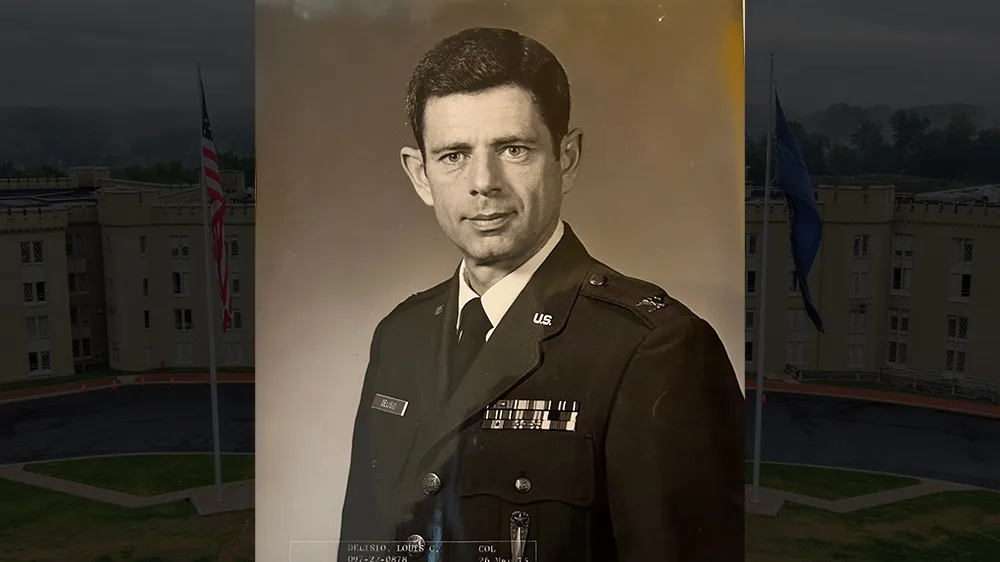
Helping Astronauts Return from The Moon
Louis Charles “Lou” Delisio ’52 made substantial contributions to national security during his 25-year U.S. Air Force career.
Louis Charles “Lou” Delisio ’52 made substantial contributions to national security during his 25-year U.S. Air Force career.
Following his graduation from VMI as an electrical engineer, Louis Charles “Lou” Delisio ’52 took a different route to success in the U.S. Air Force—not as a rated pilot, but as an engineer whose work helped bring the first American astronauts home safely from the moon. In 1969, with the help of a Pacific weather station, Delisio provided a critical weather adjustment to move the Apollo 11 splashdown away from a typhoon. This was a perilous situation, as Apollo 11 was the first mission to land on the moon, but it would have ended tragically without Delisio’s behind-the-scenes intervention.
A humble man who avoided drawing attention to himself, Delisio’s most significant contribution to his country came as project manager over the U.S. Air Force’s classified HEXAGON satellite program, which launched satellites watching over the Soviet Union during the height of the Cold War. Prior to that, he worked on reconnaissance satellites similar to HEXAGON.
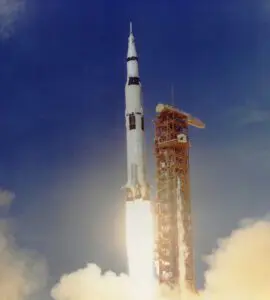
Apollo 11 launches July 16, 1969.—Photo courtesy NASA Image and Video Library.
In recognition of all that he’d done for his country, Delisio was awarded the Legion of Merit three times over the course of his career, and in one of those instances, in 1969, there were three names listed on the order granting the award: Neil Armstrong, the first man to walk on the moon; Buzz Aldrin, the second; and Delisio. It is notable that because of the extreme secrecy of the HEXAGON project and others like it, Delisio was never able to tell his family why he was being honored alongside such iconic astronauts.
Delisio was raised in Haverstraw, New York, 18 miles south of the U.S. Military Academy on the west side of the Hudson River. He attended Haverstraw High School before matriculating at VMI. He held rank for 3 years, including as a lieutenant his 1st Class year. He and future U.S. Marine Col. George Ripley ’52 were study mates and remained close all their lives.
As a 1st Class cadet, Delisio won first place for his paper on semiconductors, which was presented to the American Institute of Electrical Engineering in New Orleans, Louisiana, during Mardi Gras. His work considered that transistors could one day replace electric tubes to be more dependable and portable. Without a doubt, he was ahead of his time, as this soon came to pass. During his cadetship, Delisio was close to Col. Lee L. Nichols Jr., Class of 1944, in the electrical engineering department. He graduated in 1952 with a Bachelor of Science degree in electrical engineering and a commission in the Air Force. Soon after graduation, he married Mary Fowler, and the two had a son, Jim Delisio ’76, and a daughter, Toni.
Delisio attended initial training at the Communications Officer Course and later attended the Missile Launch Officer Course and the Squadron Officer Course. Delisio had tours in Germany, Missouri, and France before earning a Master of Science degree in aerospace engineering. This led to a change in duty to acquisition management officer with a secondary in aeronautical engineering. As a Minuteman launch control officer and launch crew commander at Malmstrom Air Force Base in Great Falls, Montana, Delisio’s crew code was Lima, and he joked that he was the head lima bean. He earned recognition for completing the Titan IIIB Design and Operational Course and came to the attention of U.S. Air Force Col. Frank Buzard, a noted figure in the space field, who had been Delisio’s first commanding officer and later recruited him to work on HEXAGON. Buzard stayed with the program until he retired in 1972 and remained a close family friend.
This work also brought Delisio to the attention of U.S. Air Force Gen. Lew Allen, who commanded the Space and Missile System Organization and later served as Air Force chief of staff. Delisio soon worked as a project officer reporting to Allen regarding the Air Force’s secret HEXAGON project based out of a building at the Los Angeles International Airport in Los Angeles, California.
Planning for HEXAGON started in the mid-1960s, and the program was active from 1971–86. The HEXAGON satellite, also called Big Bird, launched into low orbit between 110-160 miles from Earth and used reel-to-reel film to photograph and map the Earth with a resolution of 2 feet. This was a great improvement over the previous resolution of 6 feet. As a Cold War military initiative, its focus was on the Soviet Union, China, Cuba, and the Middle East, and the highly classified focus was on finding and studying missile and submarine bases. As a result of this project, it was discovered that the Soviets had far fewer strategic missiles than originally suspected. It was also able to monitor Soviet missiles to ensure compliance with the SALT I Treaty of 1972, which limited nuclear arsenals.
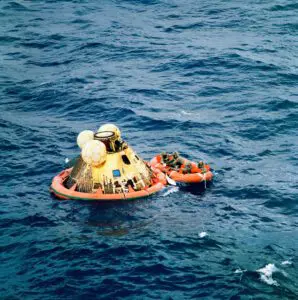
Apollo 11 crewmen await pickup after a safe landing thanks to Delisio’s weather guidance.—Photo courtesy NASA Image and Video Library.
Delisio was a lieutenant colonel project manager, which included the responsibility of capturing the film capsule when it was dropped back to Earth. C-130 aircraft were used to grab the film module’s parachute and pull it into the aircraft. Of 20 launches, 19 were successful, at a cost of $3.3 billion. At one time, over 1,000 people worked on this project, with Lockheed building the actual missile. A sample of this missile is on display at the Air Force Museum in Dayton, Ohio.
In addition to protecting the national interests of the United States during the Cold War while conducting espionage activities on the Soviet Union, Delisio also helped America’s first lunar-landing astronauts return safely from the moon July 24, 1969.
Summer is typhoon season in the Pacific Ocean, and as the time of splashdown approached, it became obvious that the plan originally developed by NASA would have Apollo 11 astronauts Armstrong, Aldrin, and Michael Collins landing in the middle of a raging storm. Because the majority of the HEXAGON program was classified, the exact details are buried in history, but it is known that, with his weather knowledge gleaned from the super-secret satellites, Delisio alerted NASA officials to the danger, and soon the landing zone was shifted to a safer site. At the time, even Delisio’s family did not know of his behind-the-scenes involvement in one of the United States’ most spectacular achievements of the 20th century.
A few years later, Delisio found time to take his son to matriculate at VMI in 1972. Young Jim had heard VMI stories but never visited the school until his dad dropped him off. Delisio taught Jim how to shine shoes and not to take things personally—great advice for VMI.
Delisio moved on to the Pentagon as a full colonel and to the Air Force staff, where he continued to manage technical projects, earning three Legions of Merit in 5 years. Among his assignments was heading the Space Division of the Air Force. There, he worked on an early warning system in case of a ballistic missile attack. During his time in the Pentagon, he renewed a friendship with an old friend, astronaut Collins of Apollo 11 fame. He had commanded the Command Module, flying 30 times around the moon, while astronauts Armstrong and Aldrin first walked on the moon. After retiring from NASA, Collins became the first director of the Smithsonian National Air & Space Museum.
After 25 years in the Air Force, Delisio and Mary decided to retire, and Delisio took a job with IBM managing their space program and later took a job with Hughes Aircraft. This quiet man retained a deep sense of duty his entire life. He enjoyed woodworking as a hobby. Delisio eventually retired again and lived to age 90, passing away in 2020. He is buried beside his wife in Arlington National Cemetery.
This article is the last one retired U.S. Army Lt. Col. James F. Dittrich ’76 wrote on VMI history for publication by the VMI Alumni Agencies. Dittrich became the historian of the VMI Alumni Association in 2018 and retired from the position in summer 2026. In those years, Dittrich brought the stories of several alumni to the attention of the VMI family. He has written about such figures as John Sergeant Wise, Class of 1866, a New Market cadet who later befriended President Ulysses Grant, stood against racial segregation in Virginia, wrote several books, and sent five sons to the Institute; Albert K. “Bert” Earnest, Class of 1938, who received two Navy Crosses for his actions at the Battle of Midway in 1942; and Frank McCarthy, Class of 1933, whose extraordinary career included wartime service on the staff of George C. Marshall, Class of 1901, and decades as a successful motion picture producer who brought the story of George S. Patton Jr., Class of 1907, to the screen (it received multiple Oscars, including Best Picture) and who was a confidant of Marshall and two presidents: Harry S. Truman and Dwight D. Eisenhower.
Dittrich’s service to the VMI family has not been limited to his historical work. He was a member of the Army ROTC staff and a tactical officer at VMI from 1983–87. A member of the VMI Alumni Association Board of Directors from 2004–26, he served on numerous committees, including the Executive Committee, and led the Alumni Engagement Committee. He was also the director of Midwest Region II from 2012–18 and for 25 years was the president of the Alumni Association’s Arkansas Chapter. He also was a member of the Class of 1976 50th Reunion Committee. Those who have known Dittrich through this service found him to be warm, friendly, and unceasingly generous with that most precious commodity: Time.
In a recent interview, Dittrich said he was drawn to share the stories of these alumni because “it gives you pride in the place.” In this, he has succeeded because, among the VMI family, these stories have increased appreciation of the Institute’s vibrant and inspiring history and a greater pride in the accomplishments of our alumni and our school’s service to the Commonwealth and our country.
We thank Dittrich for expanding the VMI family’s awareness of what he described as our “fantastic history” and for whetting our collective appetite for many more such tales.