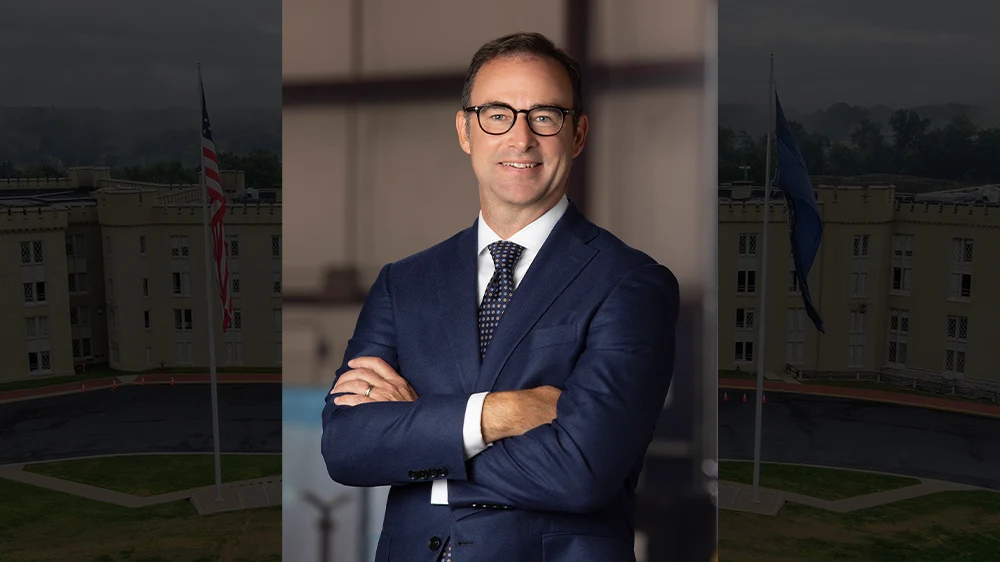
W. Lloyd Taliaferro Jr. ’95 earned a Bachelor of Science degree in mechanical engineering from VMI, graduating with distinction. During his 1st Class year, he was Company E commander, and in his 2nd and 1st Class years, he served as an Honor Court prosecutor. After serving for 4 years in the U.S. Navy, Taliaferro earned a Master of Business Administration degree from Emory University and worked in banking for several years before becoming chief financial officer of a maritime company. Today, Taliaferro is chief executive officer of Mancon LCC, a company providing business and industrial supplies to various state and federal agencies. A passionate supporter of VMI, he is a current VMI Investment Holdings, LLC, board member and a former VMI Foundation Board of Trustees member.
Q&A
Q: How did you find your way to VMI as a young person coming out of high school? What was most attractive about the Institute?
A: I grew up on a family farm in the Tidewater part of Virginia, so my weekends, holidays, and summers were mostly working alongside family on a tractor or farm machine. I was a notoriously bad farmer and had a terrible record of driving farm machinery! I laugh that I had damaged so many tractors and farm implements that the Lord (and my family) was telling me I was not meant to be a farmer.
I also grew up on the Rappahannock River, so I spent much of my free time on or around the water. So I really was kind of drawn to the travel and excitement of a Navy life. What drew me to VMI specifically was my high school principal and some other family friends who were VMI men. They were successful, respected, and self-assured. They were like giants to me.
Q: How did your cadetship influence the path you took after VMI graduation?
A: I was on a [U.S.] Navy ROTC scholarship, so my initial job out of VMI was already determined when I arrived. I was an engineering major and had an interest in math and working with numbers. Although I never practiced as an engineer, I have always taken roles that fed this interest. I served out my commitment and then went back to grad school and eventually into several finance-related jobs.
Q: Which lessons learned at VMI have stuck with you throughout your career?
A: The first lesson is to not take yourself too seriously, either successes or failures. Sometimes, your successes aren’t always due to your work; sometimes, your failures also aren’t a result of you. Whenever I’m sometimes struggling, I think, well, this is just another Rat Line, and this storm will pass. The second lesson is that life is more fun with a little bit of risk. Why run the block? Yes, because you want to be off post, but also because you might get caught. That sort of risk-taking, I think, is representative of many VMI [alums]. And then the last is a framework for life—living a life of integrity is its own reward.
Q: You have given back to VMI quite a bit in terms of time, talent, and treasure, which is not easy to do when you are busy with career and family commitments. Why did you start serving VMI? What were the rewards of doing so?
A: When I moved to Norfolk, I really knew next to nobody here professionally. Sometimes I was given a modicum of trust, or simply an introductory meeting, by virtue of the fact that I was a VMI graduate. I felt a great deal of gratitude for this and wanted to start giving back as soon as I was able. I feel like I have stood on the shoulders of alumni both individually and collectively (by reputation) and want to do what I can to pass that experience forward.
In terms of serving on the boards of the LLC and the Foundation, I feel like I’ve gotten more out of it than I’ve given. The alumni engaged there are driven and successful, and yet they’re volunteering their time and considerable talents toward current and future cadets. Being around them is a real pleasure. [And] being around current cadets, I get energized and hopeful for the future of VMI. Their energy is contagious, and they are just as irreverent and fun as we were.
Q: How has the time you’ve spent on various boards—among them the VMI Foundation Board of Trustees, the VMI Alumni Agencies Board, and VMI Investment Holdings, LLC—influenced your perspective on the Institute’s current needs?
A: I’ve seen VMI from a new level, being involved as an alumnus. It’s given me a perspective about how VMI operates. If we look at what funds VMI, tuition and fees comprise a big chunk of it, over half of it. Then about a third of it is state funding. But that means the remainder—about one quarter of annual expenses—comes from private giving. Generous alumni and faithful stewardship have filled that gap, but it must be sustained. The thing that makes VMI so distinctive and so unique requires private support.
VMI’s mission has remained virtually unchanged since its founding—that is to produce educated and honorable men and women ready to serve as military officers when and if called. The political turmoil swirling around VMI in recent years hasn’t changed that mission, nor has it changed the ethos of serving others. That focus is unique in higher education and is urgently needed in our country.
Q: If any alumni or friends of VMI asked you why he or she should serve VMI or give to it, how would you answer?
A: We’re all taught personal responsibility from the moment we meet the cadre. To paraphrase a common saying, “If not me, who? If not now, when?” I’d say start with getting involved. Try and attend an alumni network event. Hire or pave the way for success for another VMI grad. And absolutely, go back to post. The post facility is now very impressive. Walking around post will fill you with pride.
Q: If I haven’t touched on something you’d like to address, you have the last word.
A: I didn’t recognize the value of my VMI education until I’d been out several years. With some experience and perspective, you start to see similar traits of VMI people—grit, determination, candor. I realized that I picked them up at VMI. The drudgery of daily life as a cadet is tough, but it did teach me a lot. I look back and realize how valuable that was in my life, and I want to do my part to provide that to future generations of cadets.
-

Mary Price Development Writer/Communications Specialist
The development writer plays a key role in producing advancement communications. This role imagines, creates, and produces a variety of written communication to inspire donors to make gifts benefiting VMI. Utilizing journalistic features and storytelling, the development writer will produce content for areas such as Annual Giving, stewardship, and gift planning.