Featured Article
“People find purpose in the impact that they make.”
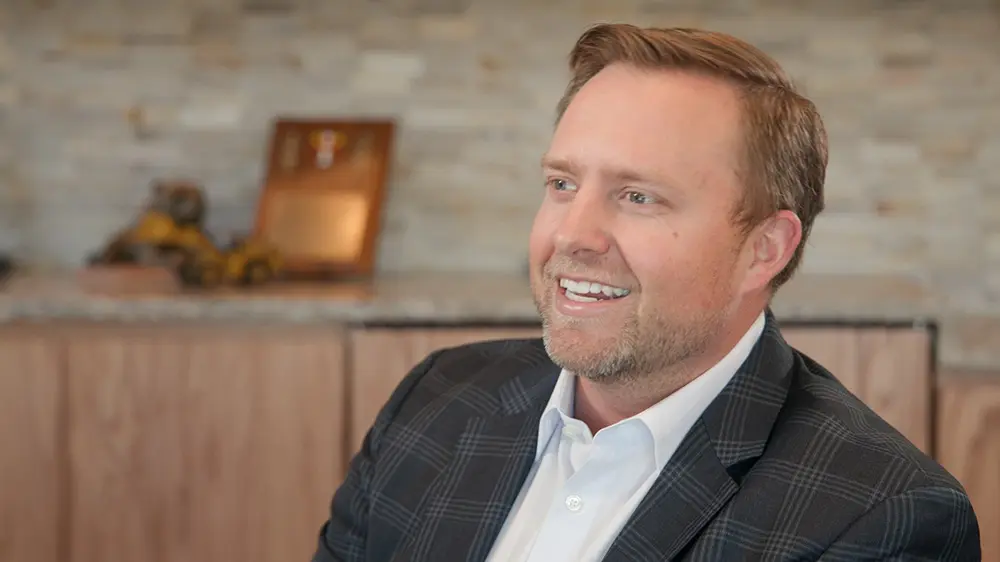
For Richard Luck ’12, a fourth-generation VMI alumnus, those words aren’t just an armchair assessment of life. They’re a mission statement and guiding principle as he uses the leadership lessons learned at VMI to guide his family business, Luck Stone, into its second century of success in business and service to the community.
It’s a big job for a company that specializes in big jobs. Luck Stone, which was founded by Luck’s great-grandfather, Charles S. Luck Jr., Class of 1920, is the nation’s largest family-owned producer of crushed stone, sand, and gravel. Virginians who don’t know the name Luck Stone have doubtless benefited from the company’s products, as the raw materials the company produces undergird critical infrastructure such as roads and bridges across the Commonwealth.
Across the decades, leadership at Luck Stone has passed from one VMI alumnus family member to another: After Charles S. Luck Jr. retired from the quarry business he founded, his son, Charles S. Luck III ’55, took over, and next came Richard Luck’s father, Charles S. Luck IV ’83. Today, Luck is taking over the reins of company leadership from his father, and as he does so, he’s guided not only by his family legacy but by everything he learned at VMI.
For someone like Luck, choosing VMI might seem to come as naturally as breathing, but it wasn’t a choice made without thought—or exposure to other alternatives. “I have so much respect for my parents in the way they kind of brought me along in my college search,” Luck stated. “They said that VMI is a place where you have to really want to be there if you want to be successful. “Their deal as parents was, we want to expose you to as many different schools as we can and take you on college tours. You have to go look at other schools.”
Luck looked around—and, in the end, decided that the Institute would provide an intangible benefit in personal growth and development.
“Looking back to when I was in high school, I really believed in this idea of being the best version of yourself, and I really wanted that,” he noted. “I wanted something that would push me to be the best version of myself. And at the time, I described that as a challenge, or something that was hard or something that was unordinary, but I really do think it was this kind of desire to grow into the best version of myself, and I felt like VMI would push me to do that in ways that other colleges wouldn’t.”
During his cadetship, Luck was a member of the Keydet football team for 2 years, where he saw firsthand the challenges and rewards of being a cadet-athlete.
“I was really excited about playing football at VMI, and I had a wonderful experience on the team,” said Luck. “I think one of the things for me that was really eye-opening was what a commitment Division I athletics is. I heard people say that to me over and over again, and then when you kind of get in it and live it day to day, you realize what a challenge and commitment it is to both be a part of the Corps, be a good student, and perform well athletically.”
The natural rhythm of a day at VMI—academics in the morning and midday, followed by an active late afternoon—was one that Luck could appreciate.
“What was really cool from my perspective was that everyone was going to do something active—to build their strength, to build their health, to be on a team, to participate, and to get stronger as a group of men and women,” he commented.
“When I think about college or higher education, it’s about who it helps you become—the leader you can become, the soft skills of how to engage in the world with humans that will be so important as we move into the future. And I don’t think there’s a school in the country that can do that better than VMI.”
Richard Luck '12
Both on and off the football field, Luck was experiencing the growth that comes from pushing past self-imposed limits and developing as a leader. “I had so many different opportunities that pushed me out of my comfort zone,” he said. “I think about running for class president and getting up in front of our class and speaking and giving a speech about why I wanted to serve. … I think about being on parade, and standing up in front of so many people and having to get everything perfect and practicing that and the nerves and then pushing yourself to do it.”
As dedicated to academics as he was to athletics, Luck was a distinguished graduate of VMI, earning a Bachelor of Arts degree in economics and business. With a desire to give back through service, Luck next taught pre-calculus and Algebra II at a public high school in Charlotte, North Carolina, through Teach for America, a nonprofit organization that recruits recent college graduates to teach in high-need areas.
And while he couldn’t impose Rat Line discipline on his students, Luck did use some tactics he’d picked up on post to make sure they were paying attention in class.
“So one of my best stories from teaching was so at VMI during the Rat Line, they’ll say ‘eyes, rats,’ as you say, ‘snap, sir,’ and ‘ears, rats,’ and you’ll say, ‘open, sir.’ That means you’re listening, and you’re listening and watching. And so I had my classes do that. So I’d say, ‘eyes class,’ and they’d say, ‘snap, sir,’ and ‘ears, class, open, sir.’ … And that was a really cool way for me to build a bond with my class and then incorporate some VMI speak and lingo quickly into my first job.”
Luck’s next career step was to found a nonprofit aimed at helping people like the parents of his students, who most often had a side hustle of some sort to help pay the bills. Working with a business partner, Luck returned to his native Richmond, Virginia, and tried to connect aspiring entrepreneurs with people who could help them get their businesses off the ground.
“What was super cool about that was there were these people that had all this drive and talent and commitment, and then there was myself and my partner at the time that had the connections,” he explained. “And so what we felt like all we had to do was be the bridge. And so much of that bridge led back to the VMI community. That was a community that wanted to help people, wanted to serve, wanted to support, and if it was someone that owned a building [for example], and we had a gentleman that was doing window washing, he could easily be kind of a helping hand to give that guy a shot, and that person still had to do a great job, but we could at least make some of those kind of first-level introductions.”
Approximately 10 years ago, Luck transitioned to the family business—and began to ponder how the values he’d learned at VMI could impact Luck Stone in the 21st century. But in doing so, he wasn’t starting from scratch, as his alumni predecessors had crafted such a strong foundation.
Approximately 20 years ago, he noted, Luck Stone underwent a corporate self-evaluation of sorts, in which company leadership made a deliberate effort to define Luck Stone’s values and put them into practice. “Our values became integrity, leadership, commitment, and creativity,” said Luck. “You see those four at VMI every single day.”
“So every day in business, you’re challenged with different dilemmas or ethical challenges that you have to work through or leadership challenges that you have to work through,” he stated. “And I think one of the things that VMI does a wonderful job of is just talking about making the right choice, like doing the right thing. And so when you’re grounded in what is the right way, what’s the right values-driven way to handle the situation, that gives you kind of a North Star pillar to make that decision from.”
Thirteen years out from graduation, Luck sees a world that’s changed quite a bit since he walked across the stage in Cameron Hall, but he also sees the timeless quality of all the Institute has given him.
“I think about higher education … the content you’re learning currently is not going to be the same content that is applicable 10 years from now,” he said. “And so, when I think about college or higher education, it’s about who it helps you become—the leader you can become, the soft skills of how to engage in the world with humans that will be so important as we move into the future. And I don’t think there’s a school in the country that can do that better than VMI.”
-

Mary Price Development Writer/Communications Specialist
The development writer plays a key role in producing advancement communications. This role imagines, creates, and produces a variety of written communication to inspire donors to make gifts benefiting VMI. Utilizing journalistic features and storytelling, the development writer will produce content for areas such as Annual Giving, stewardship, and gift planning.

Victoria Raff Digital Content Strategist
The digital content strategist is responsible for creating compelling, audience-appropriate, multi-channel content for social media, and for monitoring the VMI Alumni Agencies' social media accounts. The strategist supports all communications efforts, including video editing, website updating, and email marketing deployment and training.