Featured Article

“My True Passion”: Eger ’21 Receives Prestigious Olmsted Scholarship

U.S. Navy Lt. Jonah Eger ’21

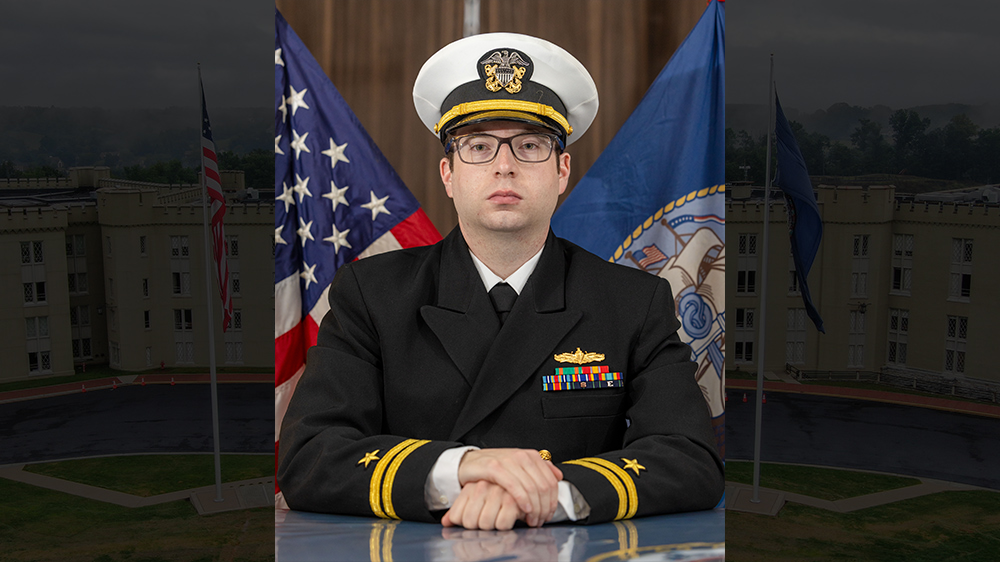
U.S. Navy Lt. Jonah Eger ‘21 in his Service Dress Blues uniform for an official portrait taken upon selection as a Class of 2027 Olmsted Scholar.—Photo courtesy Eger.

U.S. Navy Lt. Jonah Eger ’21 was one of 16 U.S. military officers named to the Olmsted Scholar Class of 2027 by the board of the Falls Church, Virginia-based Olmsted Foundation this past March. He is the only the eighth VMI alumnus selected for this prestigious program since the Institute’s first Olmsted Scholar, William Short ’77, was selected in 1982.

Originally from Ashland, Virginia, Eger was a distinguished graduate with Institute Honors who majored in economics and business. Today, Eger is a surface warfare officer currently serving on the USS Milius (DDG-69), based in Japan. He has completed four deployments in the Seventh Fleet’s area of operations and two combat deployments to the Fifth Fleet’s area of operations in support of Operation Rough Rider and Operation Epic Fury. He holds several advanced qualifications, including engineering officer of the watch, force anti-air warfare coordinator, ballistic missile defense officer, and command duty officer. Eger has received many awards, including the Navy and Marine Corps Achievement Medal with Combat “C” device and the Battle “E” award. He was promoted to lieutenant (junior grade) and lieutenant in June 2023 and June 2025, respectively.

Eger had an interest in international affairs before his time at VMI. However, what he describes as “his true passion” for the subject stems from an experience he had as a cadet. “I spent a summer in Fez, Morocco, studying Arabic, Darija, and Moroccan culture at the Arabic Language Institute in Fez through the Project GO Scholarship. I lived with a Moroccan family in the heart of the Fez Medina. This amazing exposure to a foreign language and culture sparked my desire to live abroad and my professional interest in international affairs.”

Eger and U.S. Army Capt. Adam Fodness ’21 on their study abroad in Morocco, which inspired Eger’s love for learning foreign languages and cultures.—Photo courtesy Eger.

Later, working with his mentor, Col. Atin Basuchoudhary, Ph.D., professor of economics and business, he completed an honors thesis in which he developed a machine-learning algorithm to identify socioeconomic predictors of poverty in developing nations. During his 1st Class year, he participated in the International Law of Armed Conflict Competition, hosted annually by the International Institute of Humanitarian Law. Disappointingly, COVID-19 restrictions prevented Eger and his teammates from traveling to the usual location in Italy.

Eger credits his VMI experience for leading him to this moment. “Without VMI, I never would have made it this far. Coming from humble beginnings, I never imagined there were opportunities like the Olmsted Scholar program. VMI’s ethos of service directly contributed to my decision to pursue a commission in the U.S. Navy. Without VMI, I would never have received the NROTC scholarship and other money that helped me afford my undergraduate education. Without the leaders at VMI who believed in me, I never would have been selected for Project GO and sent to Morocco, where I developed my passion for international affairs, foreign languages and cultures, and building connections with people of all backgrounds.”

Established in 1960, the Olmsted Scholar Program is the foundation’s signature program. It was born from the experiences of Maj. Gen. George H. Olmsted, the foundation’s creator. After graduating from the U.S. Military Academy in 1922 and serving in the U.S. Army, Olmsted returned to Iowa. There, he joined the insurance industry, started his own company, and, by 1940, had developed it into one of the country’s leading insurers.

Recalled to active duty during World War II, he ran the Lend-Lease program, which provided U.S.-built equipment and materiel to Allied nations. He later served on the staff of Army Lt. Gen. Albert C. Wedemeyer, who concurrently served as the commander of U.S. forces in China and the chief of staff to Generalissimo Chiang Kai-shek, leader of the Republic of China.

He returned to his company after the war but was called to the colors again when the Korean War broke out in June 1950. As a brigadier general, Olmsted was responsible for the Army’s military assistance activities. In 1951, he was promoted to major general and reassigned to the Office of the Secretary of Defense, where he led all U.S. government military assistance programs.

Olmsted expanded his business interests after he returned to civilian life in 1953. By the late 1950s, he had established International Bank, headquartered in Washington, D.C., a conglomerate encompassing insurance, banking, shipping, and manufacturing.

According to retired U.S. Army Col. Mark Elfendahl, president and chief executive officer of The Olmsted Foundation and a 1999 Olmsted Scholar, this experience formed in Olmsted a conviction that “the greatest leaders must be educated broadly.” The program does so by providing highly qualified, active-duty junior officers with scholarships to study a foreign language for 1 year and then attend graduate school in a country where that language is spoken. To date, the program has sent 815 officers to more than 60 countries where they have studied at more than 200 universities in 40 languages.

“Without VMI, I never would have made it this far. Coming from humble beginnings, I never imagined there were opportunities like the Olmsted Scholar program.”

U.S. Navy Lt. Jonah Eger ’21 Olmsted Scholar

“The program shapes future leaders by developing in them a strategic awareness of the world and an understanding of how America can best lead it,” Elfendahl continued. “That, in turn, strengthens American leadership around the world and advances the interests of the United States across the national security environment.”

Elfendahl stressed that the program purposefully restricts applicants to those officers who have served between 3 and 11 years on active duty. “We want to ensure that the scholars have been acculturated to the profession of arms and the ethos of military service. We want them to have served with their peers, experienced the challenges of basic military leadership, and demonstrated excellence at the tactical level.” This is important because the program’s goal is to serve the nation by giving scholars the knowledge, perspective, and confidence to succeed as senior warfighting commanders who will be “strategic assets to their services and the Joint Force.” Evidence of the program’s success in achieving that goal is that 52 scholars have achieved general or flag officer rank, and eight of these have attained four-star rank.

Eger was motivated to apply for the Olmsted Scholar program because “I could readily see that there are countless benefits, both personally and professionally, from this experience. I have always loved school, and studying languages comes naturally to me. To have the time to focus on getting a master’s degree and developing language and cultural proficiency in another country would be a dream come true.”

Eger onboard the USS MILIUS DDG-69, where he served as the training officer during the inbound transit returning to Yokosuka, Japan, from deployment.—Photo courtesy Eger.

Each service has its own way of determining which candidates are best fitted for the program. After each of the six services chooses its candidates, it forwards scholarship “packets” to the Olmsted Foundation. Usually, there are approximately 70 a year. After reviewing the applications, the foundation’s staff interview candidates by telephone. “We do that,” explains Elfendahl, “because some are deployed or in a war zone, and we don’t want to put them at a disadvantage.” Afterward, the foundation’s board chooses the new class. Each service’s number of selectees reflects its relative size. The Army, Air Force, and Navy usually have four scholars each per year; the Marines usually have two, and the Coast Guard and Space Force have one each. All told, the process takes approximately 9 months.

Eger learned of his selection March 19, 2026. At the time, he was engaged in combat operations in support of Operation Epic Fury. “To say it was an emotional moment is a complete understatement,” recalls Eger. “When my captain told me the news, I could not believe it initially. Not only had I been selected, but I had been picked to go to my first choice of location: Lisbon, Portugal.”

Asked why he had chosen Portugal among his top destinations (candidates must submit 10), he replied, “It is completely different from any place I’ve been before. I’ve lived in Morocco and studied Arabic. I’ve lived in Japan and familiarized myself with its culture. I’ve never been to Europe, and I wanted to be in a place that had an interesting history that I don’t know much about. Portugal also has a great maritime tradition, and living there would give me the opportunity to do some sailing.”

One of the program’s peculiarities is that, while Olmsted Scholars receive their military pay and allowances and some financial support from the Olmsted Foundation, they have no official status. They are required, therefore, to handle all the details of their stay. As Elfendahl puts it, “They must find housing, figure out where to shop, how to get around, and how to work within the local healthcare system. That’s part of the program’s value. It gives scholars a new set of experiences, boosts their self-confidence, and enhances their leadership abilities.”

Eger welcomes this. “It’s an important part of the Olmsted experience. I will be fully immersed in the day-to-day lives of the locals and so better understand their financial and social obligations. I am most looking forward to making friends with the locals, conversing with them in their language, and building a sense of community. I also love traveling, and I cannot wait to explore the rich history, culture, and food that Portugal has to offer.”

For the past 5-and-a-half years, Eger has been on extremely demanding and challenging sea tours. Of the past 19 months, he has spent 15 months at sea—and 11 of them have been on combat deployments. So, while he is eager to learn a new language and study for an advanced degree in Portugal, he will be happy to live at a relatively slower pace. “I am looking forward to using this unparalleled opportunity to focus on improving my physical, mental, and spiritual fitness in order to strengthen my character and leadership abilities for the rest of my Navy career.”

Just as he will apply his prior experiences to the Olmsted program, he will apply what he learns from the program to his naval career. “Afterward, I’ll return to the fleet as a department head on an operational ship. I am determined, therefore, to use my time as an Olmsted Scholar to make myself a better person, leader, and sailor and so return to the Navy with even more to contribute.” More specifically, Eger hopes to get a ship assigned to the Navy’s Forward Deployed Naval Forces—Europe, based in Rota, Spain. “There, I can offer ‘the best return on investment’ by applying the cultural knowledge and language fluency I’ll acquire during my Olmsted tour.”

All that is 3 years in the future. Right now, Eger is anticipating an experience that he describes as “the perfect crossroad of my personal and professional interests. Undoubtedly, it will offer unmatched rewards. I am incredibly grateful to the Olmsted Foundation for selecting me for this rare opportunity.”

  • Scott Belliveau

    Scott Belliveau '83 Communications Officer - Executive Projects

    The communications officer supports the strategy for all communications, including web content, public relations messages and collateral pieces in order to articulate and promote the mission of the VMI Alumni Agencies and promote philanthropy among varied constituencies.