Featured Article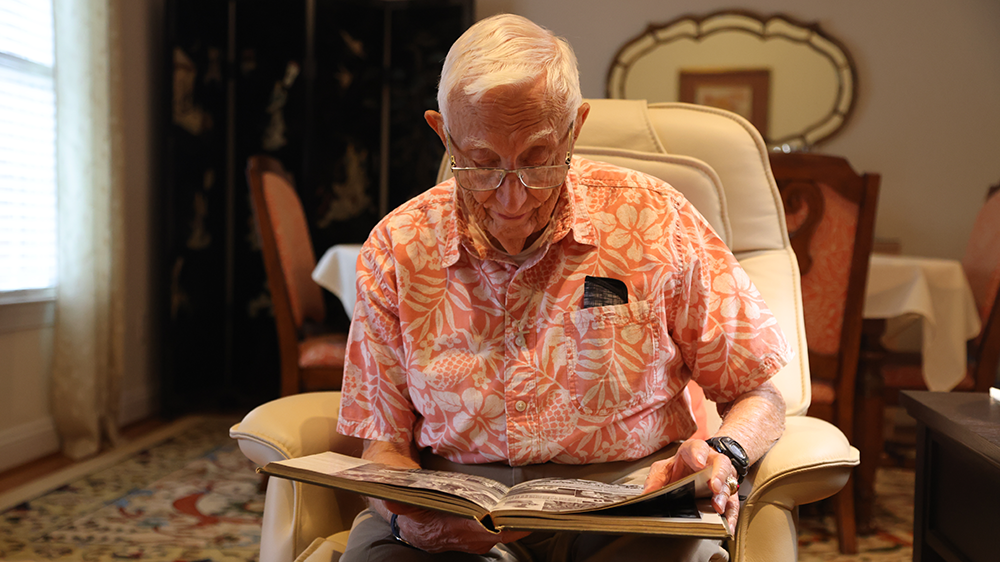
Ding Patton ’49B: “VMI Is So Unusual”
James “Ding” Patton ’49B looks through the 1949 Bomb at his home in Staunton, Virginia, in September 2026.
James “Ding” Patton ’49B looks through the 1949 Bomb at his home in Staunton, Virginia, in September 2026.
In the early years of World War II, while the walls of the Pentagon rose at a fevered pace of construction near the banks of the Potomac River, Herndon, Virginia, was a small farming community where dairy cows grazed and many people made their living from agriculture. In town, a teenager quietly worked at his father’s grocery store, breaking up 100-pound bags of potatoes and putting them into 5- and 10-pound bags for shoppers to buy.
That teenager’s name was James “Ding” Patton ’49B, and he used the money he earned from the grocery store job to pay for most of his tuition at VMI. “I paid my way down there, and not many kids can say that,” Patton noted. He began working at the tender age of 12, when he started delivering his father’s lunch to the store and was invited to stay and help out.
Now 98 years old and living in Staunton, Virginia, Patton is the VMI Alumni Association’s oldest class agent, a scholarship donor, and a resolutely loyal alumnus. A lifelong disability of being blind in one eye due to a sledding accident at age 10 hasn’t slowed him down a bit. Other than military service, he’s been able to accomplish anything he sets his mind to.
Patton is known for a cheerful demeanor forged by a lifetime of hard work, and he greets visitors to the home he shares with his wife, Ella “Nobbie” Patton, with a hearty, “Come in the house!” The Pattons, who met in Northern Virginia and raised four children together, have been married for an incredible 76 years.
“After Nobbie, the best move I ever made was going to VMI,” he said.
But in summer 1945, at age 16, Patton was just another young man looking for a future, and after seeing the 1938 movie “Brother Rat,” starring Ronald Reagan, he decided the Institute was the place for him. A family connection helped, too; his father’s cousin, “Curl” Patton, was stationed with the U.S. cavalry at VMI then.
With the war in the Pacific still raging, the Institute’s wartime schedule was in effect when Patton and his brother rats matriculated July 11, 1945. The early arrival was designed to help cadets squeeze three semesters into the academic year so they could get as much education as possible before entering military service.
And in that era, with gas rationing in effect and slow travel on two-lane roads, parents didn’t make the drive to Lexington. Asked to recall his trip to Lexington, Patton recounted an unceremonious parting: “My parents took me out from Herndon to Chantilly and dropped me off with a suitcase to wait for a bus.”
“VMI is so unusual, with the emphasis on respect, honor, and integrity. I felt that in many respects, the things VMI stood for were the things that my family had tried to instill in me growing up too.”
James “Ding” Patton ’49B
It was not, though, a lonely ride. A high school friend, Carel Humme ’49B, had also decided to enroll at VMI, and so the two of them waited for the bus. “We got on the bus, and another guy looked as scared as we did sitting there, and I went back and started talking to him, and he ended up being my roommate,” noted Patton. He’d just met John Haggerty ’49B, who would become a lifelong friend.
“We got there and got let off the bus at McCrum’s Drug Store and took a taxi up to [VMI],” Patton continued. “They took us down to the [quartermaster’s department], gave us a laundry bag to fill full of stuff, and then we got back from there, walked back to the barracks, and the world fell in.” The Rat Line had begun, and the cadre didn’t hold back.
News from the outside world was sparse that summer, even as the war with Japan ground on to a conclusion that shattered the world’s old order. Rats couldn’t have radios in their rooms, but older cadets could. Patton remembers reception was a problem during the day, but much better at night. “At nighttime, we could get Del Rio, Texas,” he noted. That was the case, he recalled, because while the radio station was based in Texas, the transmitter was in Mexico, and Mexico allowed much stronger radio signals.
With a long-term interest in building houses back home in Northern Virginia, Patton chose to major in civil engineering, graduating in January 1949 because he’d come in under the Institute’s accelerated wartime schedule. At the time, an advanced degree wasn’t a strict requirement to teach at VMI, so Col. Robert “Buzz” Marr, Class of 1918, professor of civil engineering, hired Patton to teach in that department. During his 2 years on the faculty, Patton served as an academic advisor to some cadets, including Lt. Gen. John W. Knapp ’54, the Institute’s 12th superintendent.
When plans to stay in Lexington didn’t work out, the Pattons moved to Northern Virginia, where, thanks to a connection with Roy Dunn, Class of 1931, Patton began work in an office responsible for regulating subdivision construction in Fairfax County. Soon, though, he found himself heading back down U.S. Route 11 to VMI.
“Eight months later, I went back to VMI to a highway conference,” he related. There, Patton had dinner with a member of the Fairfax County Board of Supervisors, and the two men decided to go into business together, establishing separate construction and engineering firms. In the long run, Patton founded his own firm and continued to work on projects that would prove to be vital to Northern Virginia’s continued expansion, including a 26-mile waterline construction project through Fairfax and Loudoun counties in the late 1950s.
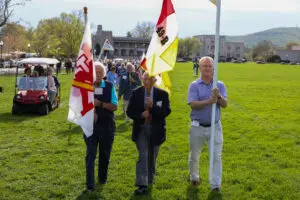
James “Ding” Patton ’49B carries the Class of 1949B flag into barracks for Old Yells during the 75th Reunion in April 2024. With him are (left) Tom Altizer ’49B and Joe Haggerty (HBR ’49B), son of John Haggerty ’49B.
Patton retired in 1991, and since then, he and Nobbie have traveled the world, visiting Russia twice. The two have also been to China, India, and Egypt, and Patton made a second journey to Africa when he visited Rwanda on a church mission trip. They’ve also stayed busy with their family, keeping up with children Jean, Cindy, Jim, and Steve ’85. A grandson, David Baber ’02, is also an alum, making the Pattons a three-generation VMI family.
“I love my brother rats, and I love the school,” said Patton when asked what’s sustained his involvement over many decades. He’s also well aware that young people today can’t put potatoes into bags to pay for a college education, and that’s why he makes giving to VMI a high priority.
“I had to do my own thing when I was a kid to raise money. I paid my own way there, and I feel sorry for families who have financial problems, maybe can’t do it, and I just want to help,” he noted.
“VMI is so unusual, with the emphasis on respect, honor, and integrity,” he continued. “I felt that in many respects, the things VMI stood for were the things that my family had tried to instill in me growing up too. There wasn’t much difference.”
More than anything, the emotion Patton feels for VMI is pride, and he’s especially glad to have had the opportunity to teach at the Institute. Years ago, he recalls receiving the Register of Former Cadets in the mail and seeing his name listed in the former faculty section.
“They used to have the list of all the faculty members who have ever been there, and I looked at my name with some of these really wonderful people who had taught there, and I said, ‘I just feel I’ve been so privileged to even have my name on the same piece of paper with those people.’”

The communications officer – features leads the creation of compelling, mission-driven written content that often supports fundraising and donor engagement efforts. In addition to crafting development-focused communications, this role contributes to the editorial success of key Alumni Agencies publications through strategic, long-form storytelling and by maintaining close working relationships with volunteer leaders.