Featured Article
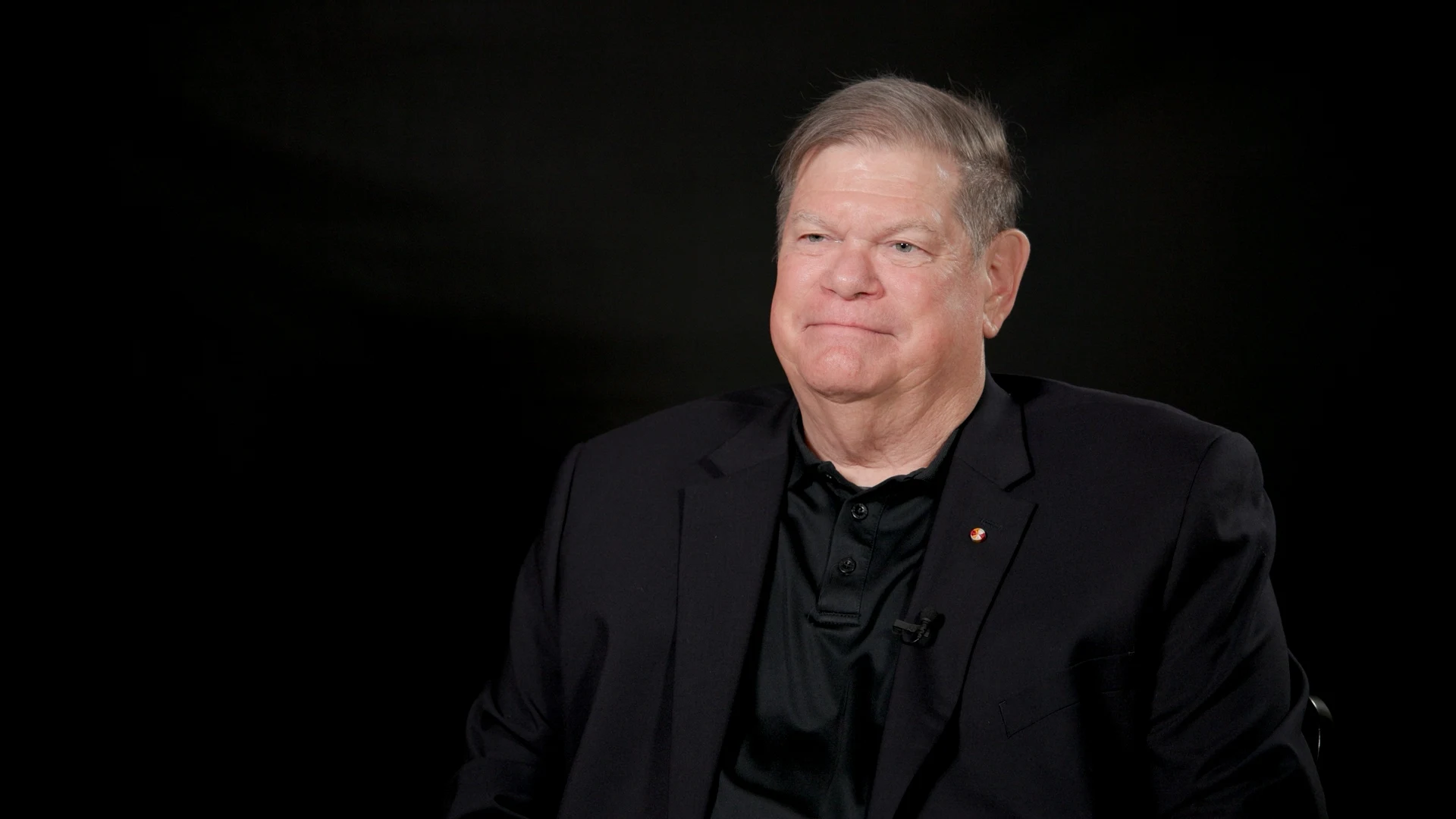
When asked what’s motivated him to interview dozens of alumni and their family members about their impressive lives, many of which have involved significant military valor, Jim Dittrich ’76, recently retired VMI Alumni Association historian, had a simple answer: “I love to talk to VMI people.”
Dittrich, who served as historian from 2018 until his retirement from the position in June 2026, has told the stories of some of VMI’s most legendary graduates of the past century, including but not limited to retired U.S. Air Force Col. Thomas “Tom” Kirk ’50B, who spent 5-and-a-half years as a prisoner of war in Vietnam and today is the Institute’s most highly decorated living alumnus; U.S. Marine Corps Col. William “Bill” Dabney ’61, who commanded U.S. troops at Khe Sanh, which has been called “one of the defining battles in Marine Corps history; and Edward “Ned” Schowalter ’51, the Institute’s most recent Medal of Honor alumnus recipient.
Telling those stories took weeks and months of unpaid time, and Dittrich traveled at his own expense. He’ll be the first to tell you, though, that the joy of bringing these stories and more to light was ample reward.
“It gives you the pride in [VMI], and I think that in my day, there was so much focus on the Civil War, but I found that the 20th century is much more exciting to me … We have a fantastic history, and I think it’s going to get better,” he noted.
The lure of studying history helped draw Dittrich to the Institute when he began looking at colleges in the early 1970s. He’d thought about the U.S. Military Academy, but West Point was then known more for its engineering programs, and a visit to VMI quickly assured the teenage Dittrich that he’d found his school.
“I met the regimental commander from the Class of ’72, who was an impressive guy, and the rest is history,” he stated. Once the dust had settled from matriculation, Dittrich forged through the Rat Line, made friends, and quickly found himself benefiting from the mentorship provided by faculty members such as Col. Herbert N. “Dodo” Dillard ’34, Ph.D.; Col. John G. Barrett ’44, Ph.D.; and Col. Alexander H. Morrison ’39, Ph.D. “Those guys kept me here—their interest in me personally, and their ability to teach,” he said.
Outside the classroom, Dittrich and his brother rats found time for some collegiate escapades, including a nocturnal trip to Virginia Tech to surreptitiously paint the Hokies’ football stadium in VMI colors.
“I got out of the car with a paint bucket and a brush in hand,” he recalled. “I took about two steps, and out of the woods came, I would estimate, 300 Hokies … running in our direction with at least four police cars with them.”
Dittrich and his companions were let go with a warning and returned to barracks, where they settled back in, seemingly undetected. The next morning, though, Dittrich received a summons to see Col. William “Buck” Buchanan ’50B, commandant. Unsurprisingly, Buchanan knew exactly what had transpired the night before, and he didn’t mince words.
“For a guy who wants to be an Army officer, you’ve not started off very well,” Dittrich recalled Buchanan as saying. “Your first raid—and you’re a failure. Now get the heck out of my office before I change my mind, and I hope never to see you again in here.” Dittrich departed quickly.
“And if I could fly, I think I did, because I don’t remember touching the floor as I departed, but that’s how it went.”
“It gives you the pride in [VMI] … we have a fantastic history, and I think it’s going to get better.”
Jim Dittrich ’76
After graduating with a Bachelor of Arts degree in history, Dittrich served for 22 years in the U.S. Army, and his duty stations included a stop at VMI as a tactical officer and ROTC instructor in the mid-1980s. Being in the Army gave Dittrich his first look at how others view the Institute.
“I think VMI is a school of leadership,” he observed. “You hear we’re the school of the citizen- soldier, as well, but the school of leadership is how I think of VMI. When I got to the Army, I found that VMI guys were better prepared than other schools. … For a time, I was the only non-West Point company commander in my infantry battalion.”
Dittrich’s military career ended in the 1990s when he became a single parent with custody of his three children—a situation he’d never foreseen. “I had just come out on the colonel’s list, and things were good, but life changes for a reason, and VMI taught me about being positive. You overcome adversity. We overcame a lot of adversity,” he said.
After a short stay in Ohio, Dittrich and his children settled in Little Rock, Arkansas, where he met and married his wife, Tish. Soon thereafter, a chance encounter during a VMI reunion weekend brought Dittrich into a deeper level of involvement with the Institute. He’d gone into a Lexington bookstore to look for books about World War II, and while there, he ran into a former VMI history professor, Col. Tyson “Ty Ty” Wilson, Ph.D., who told Dittrich he’d been in some of the battles Dittrich was reading about.
Wilson became Dittrich’s first interview subject, and from there, others followed. “I love history, and they all had great stories to tell,” said Dittrich. “It’s fascinating to me, and I wanted a record of it so VMI has all these stories.”
Serving as historian, while a labor of love, has been just one of Dittrich’s many ways of supporting the Institute. He’s also the Arkansas Chapter president, a former member of the Alumni Association Board of Directors, former Midwest Region II director, and a Class of 1976 Reunion Committee member.
From those activities, he’s learned that engagement with the VMI family doesn’t require a large outlay of money or an upscale venue. “My wife is a great country cook,” he said. “We do an annual picnic at our place, and that tends to be the most attended. They come from all over Arkansas, and we have fish. And we have corn fritters and hush puppies. And when I say fish, it’s fried catfish that brings them in.”
As he settles into retirement from his position as historian, Dittrich is equally proud of the work he’s done in bringing untold VMI stories to light and eager to see what his successor, Richard “Rick” Wolffe ’78, will choose to write about.
“You can go online and type in any of these names that I’ve mentioned and see their story—just amazing stories of what our alums have done, and now the women coming in,” said Dittrich. “There are great stories coming.”
-

Mary Price Communications Officer – Features
The communications officer – features leads the creation of compelling, mission-driven written content that often supports fundraising and donor engagement efforts. In addition to crafting development-focused communications, this role contributes to the editorial success of key Alumni Agencies publications through strategic, long-form storytelling and by maintaining close working relationships with volunteer leaders.

Victoria Raff Digital Content Strategist
The digital content strategist is responsible for creating compelling, audience-appropriate, multi-channel content for social media, and for monitoring the VMI Alumni Agencies' social media accounts. The strategist supports all communications efforts, including video editing, website updating, and email marketing deployment and training.