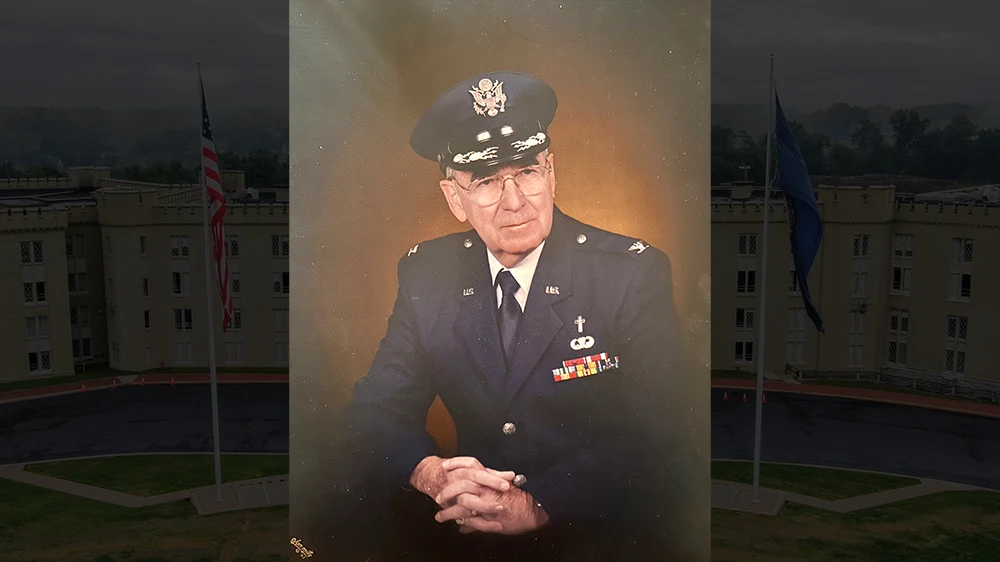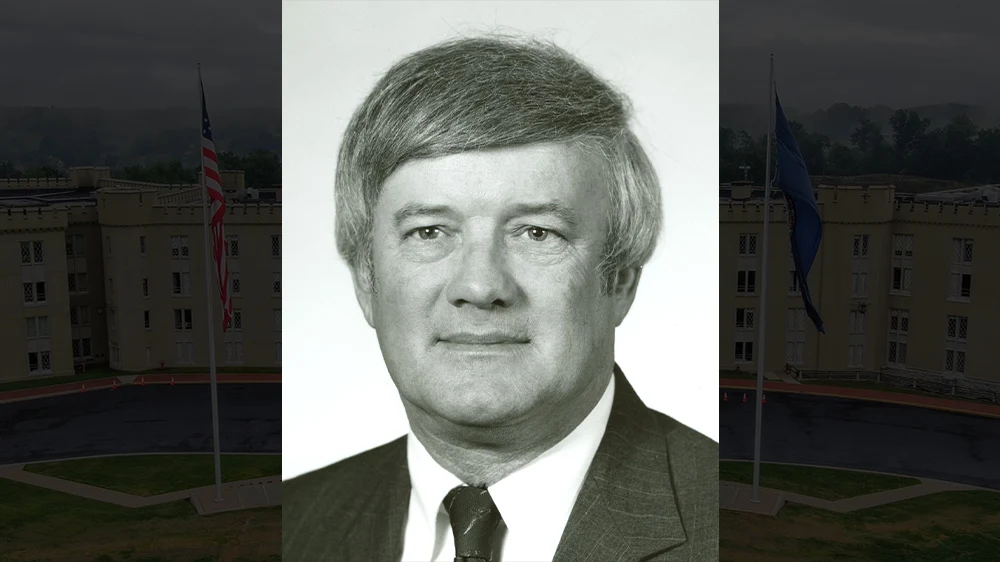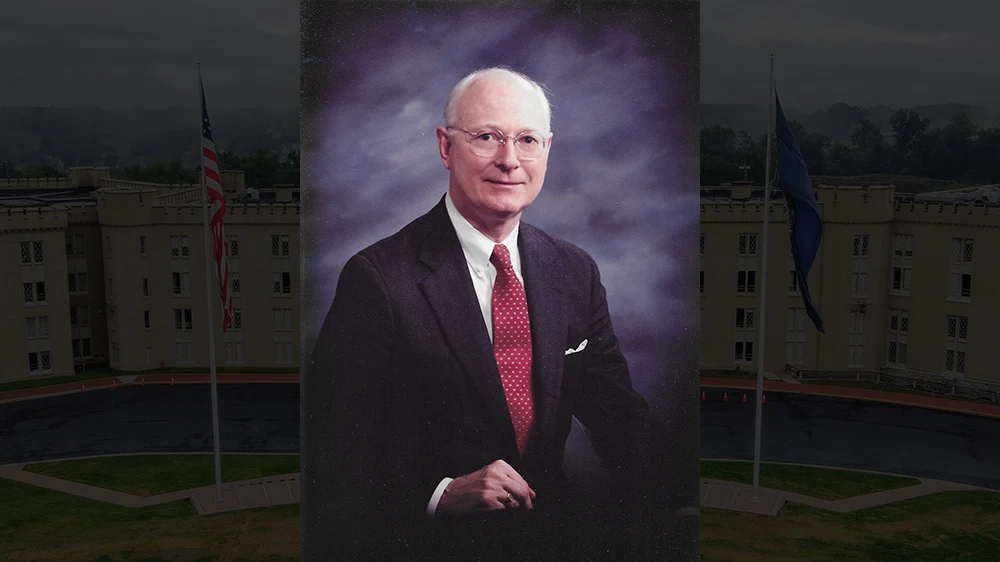
Joseph M. Spivey III ’57, former VMI Board of Visitors president, VMI Foundation Distinguished Service Award recipient, and longtime leader of Virginia’s legal community, died Aug. 17, 2025. He was 90.
Described by George W. Sydnor Jr. ’57, his brother rat, as “a dedicated cadet with a dry, subtle sense of humor,” Spivey was a corporal and a sergeant, but as Sydnor put it, he gave “much more serious attention to academics.” Yet, he was not all work and no play, despite his “serious demeanor,” Sydnor described. He was “fun to be with and could find humor in any type of situation.”
Spivey participated in several activities during his cadetship, including the American Society of Civil Engineers and the Canterbury Club, and devoted much of his time outside of the classroom to the swimming and diving team. A 4-year member of the team, he was its co-captain during his 1st Class year, and according to his history in the Bomb, “established himself as one of the outstanding backstroke swimmers in the state.”
A distinguished military graduate, Spivey commissioned in the U.S. Army field artillery branch. The Army transferred him to air defense artillery, and after training at Fort Bliss, Texas, he served on active duty for more than 2 years. He then served as a citizen-soldier with the U.S. Army Reserve from 1959–62 and the Virginia National Guard from 1962–64. He left military service as a captain.
After his active duty service, Spivey briefly worked for Procter & Gamble before enrolling at Washington and Lee University School of Law. He was the editor-in-chief of the Washington and Lee Law Review and was named to both the Order of the Coif, a legal honors society that recognizes graduates in the top 10% of their class, and Omicron Delta Kappa, the national leadership honor society, which “recognizes and encourages superior leadership and exemplary character.”
After graduating from law school, Spivey joined the Richmond-based law firm of Hunton, Williams, Gay, Powell, and Gibson (now Hunton Andrews Kurth LLP, known widely as Hunton). He stayed with the firm for almost four decades, developing a national reputation as an effective litigator and trial attorney handling a wide variety of cases. He was an associate from 1962–69, became a partner in 1969, took on “of counsel” status in 1993, and fully retired in 2001.
Although he tried several high-profile cases across the country, he is perhaps best known among Virginia’s legal community for his leadership during the 5-year defense of Allied Chemical Corporation in one of the largest environmental lawsuits in Virginia history. Besides admiring his accomplishments in the courtroom, his fellow lawyers at Hunton appreciated the example he provided as an attorney, colleague, and mentor. Alan Rudlin, a retired partner at Hunton, said, “[Spivey] had a wonderful sense of what was right and what was practical, and he combined those qualities to be a mentor to me from whom I learned a great deal and to whom I owe a great debt. He knew how to practice law with complete commitment and creativity. And he also knew how to have fun.”
“In my four decades at the Institute, I cannot name a person whose contributions exceeded [Joe’s] or whose force of intellect, character, and spirit have had more good effect.”
Maj. Gen. John W. Knapp Sr. ’54
Thomas G. Slater Jr. ’66, a former BOV president like Spivey and now a special counsel at Hunton, said of him, “As a young trial lawyer, he taught me one of the best lessons I could ever receive: The importance of always shooting straight with judges and other lawyers. Joe taught me that ‘if a judge asks you a question you do not know the answer to, tell the judge you cannot answer it, but you will quickly work to get the answer.’ A trial lawyer’s reputation is his greatest asset.”
Spivey was a member of the Virginia Bar Association and the American Bar Association and served as the Richmond Bar Association president from 1982–83. He was also elected a fellow of the American College of Trial Lawyers, an honor granted to only 1% of American trial lawyers. Spivey returned to Washington and Lee University School of Law as an adjunct professor from 1997–99 and a visiting professor from 1999–2001.
Spivey was appointed to the VMI Board of Visitors in 1983. He served on several committees, including the Audit, Finance, and Planning Committee, as well as the Sesquicentennial Steering Committee. In 1987, he became the board’s president, serving in the position for 4 years. In 1988, he served as chairman of the Superintendent Search Committee, which was formed after the retirement of Gen. Sam Walker ’45, the Institute’s 11th superintendent. The board would choose then-Maj. Gen. John W. Knapp Sr. ’54, then-dean of the faculty, to succeed Walker. Spivey would say of his board service, “[It] was, without qualification, the greatest experience of my life.”
In March 1990, the U.S. Justice Department sued Virginia, alleging VMI’s all-male admissions policy violated the 14th Amendment. George H. Roberts Jr. ’68, who served as the VMI Foundation executive vice president from 1991–98, recalled “the profound impact” Spivey’s leadership had on VMI’s reaction. “It was on his watch as BOV president that fundamental decisions were made concerning whether and how VMI would undertake a long and challenging period of litigation to preserve its historic all-male student policy. The Board of Visitors concluded, with Joe’s leadership and the guidance of former U.S. Attorney General Griffin Bell; our lead attorney, Robert H. Patterson Jr. ’49C; and other leading lawyers, that a case could and should be made for state-sponsored single-sex education.
“Once the decision was made to proceed, Joe played a pivotal role, exercising his sound judgment in the numerous major and often difficult decisions that needed to be made during the course of that litigation,” Roberts said.
VMI’s legal team was successful in the U.S. District Court and in the U.S. 4th Circuit Court of Appeals, and the U.S. Supreme Court decided in favor of the U.S. Justice Department in June 1996. Years after the case’s conclusion, the successful integration of women into VMI’s ranks stands as a milestone worth celebrating. Throughout the litigation that reached the nation’s highest court, Spivey’s unwavering professionalism was consistently recognized.
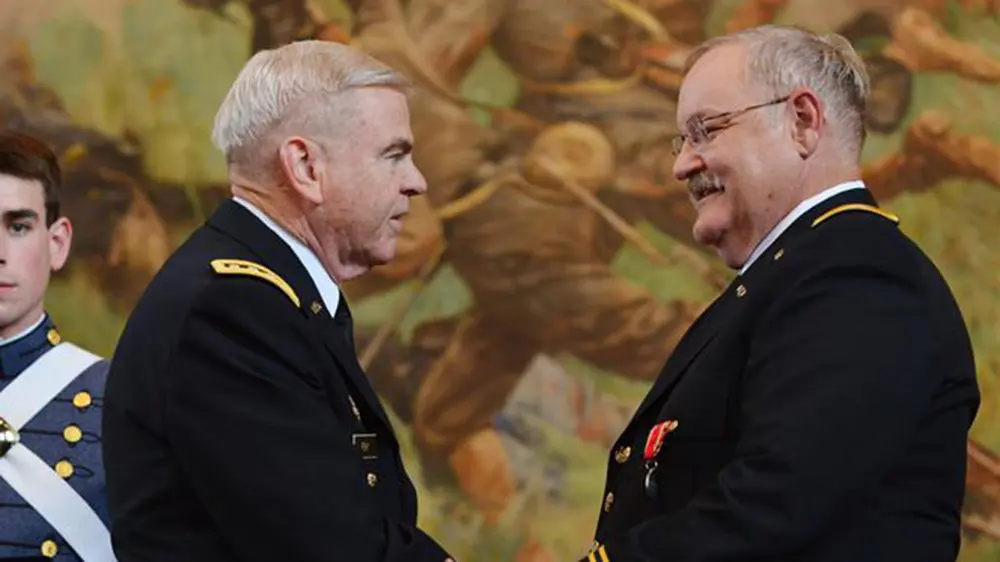
In its May 1991 resolution honoring Spivey, the BOV stated, “His leadership has been strong and sound, providing constructive guidance and a stabilizing influence in all matters which have come before him.” Knapp wrote in a July 1991 letter to Spivey, “In my four decades at the Institute, I cannot name a person whose contributions exceeded yours or whose force of intellect, character, and spirit have had more good effect.”
The VMI Foundation presented Spivey with its Distinguished Service Award in 1994. In his remarks, he said, “This award … is the highest accolade I have ever received, and to be honored this way by an institution I so cherish and respect fills me with an emotion I can scarcely express.”
Keenly interested in American history and education, Spivey served on the boards of the Shenandoah Valley Civil War Roundtable; the Stonewall Jackson Foundation; and Southern Virginia University, formerly Southern Seminary. He also supported the George C. Marshall Foundation.
Spivey is survived by his wife of 67 years, Ann Dare (née Davis); three sons, Joseph M. Spivey IV ’85, Timothy A.W. Spivey ’86, and Thomas N.C. Spivey ’89, and their respective spouses; and eight grandchildren.
-

Scott Belliveau '83 Communications Officer - Executive Projects
The communications officer supports the strategy for all communications, including web content, public relations messages and collateral pieces in order to articulate and promote the mission of the VMI Alumni Agencies and promote philanthropy among varied constituencies.