Featured Article
“I think what this place instilled in me more than anything else was just a commitment to do my best at anything I tried and a commitment to excellence as a habit and not an act. One time is easy—doesn’t get you anywhere. It needs to be a day-on, stay-on type of activity.”
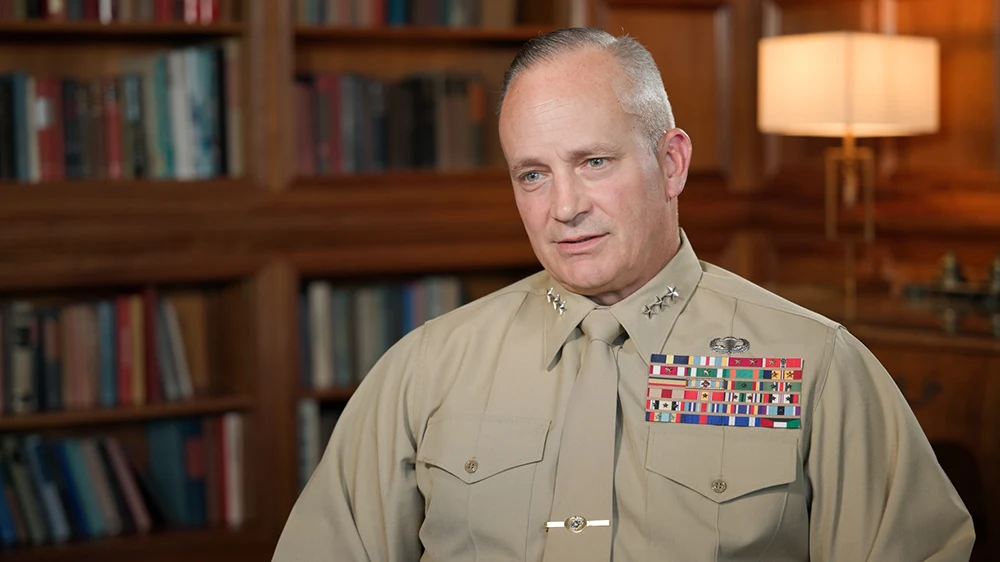
That’s how Lt. Gen. David Furness ’87, the Institute’s 16th superintendent, describes his transformational journey as a cadet—a journey that now serves as his guiding star as he settles in to lead the Corps of Cadets and serve as the public face of VMI to alumni, legislators, and the world at large after a military career that spanned 36 years and seven deployments, culminating with his retirement as a lieutenant general in the U.S. Marine Corps.
As he navigated the first 100 days of his superintendency, meeting almost immediately with cadets, faculty, staff, alumni, and friends of the Institute, Furness sought to spread a clear and consistent message: VMI is in a strong position, and the adjustments he seeks to make—most notably in the areas of recruitment and retention—are designed to reinforce that strength.
“I’d like alumni to know that the foundations that define the VMI experience are just as good today as they were when [they] were here,” Furness stated. “They may be different, they may appear to be different, but they’re as good. The outcome is the same. … The product we produce is singularly excellent, uniformly so.
“I am focused and clear about the uniqueness, the not-so-ordinary way VMI approaches preparing high-caliber young men and women for their lives ahead. I am also present to the fact that this journey is not for everyone.” It is this link between recruiting individuals who are ready to take on the challenges of the VMI experience and retaining their trust and dedication to embrace the finish line of graduation that guides his course. “Those two datapoints are critical when sustaining the reputation of VMI and the graduates we produce.”
Feeling drawn to a military career, Furness applied to the Institute on the recommendation of a family friend and neighbor, John Goode ’67. He will tell you that his decision to obtain a VMI diploma definitely took determination and a steadfast belief in its value, as he applied three times before he was accepted. Having been unsuccessful in his previous applications, he enrolled at Virginia Commonwealth University, where his then-girlfriend and now-wife, Lynda Furness, was a student, to increase his chances of acceptance.
During his third application process, Goode intervened, setting up an interview for Furness with Col. William “Buck” Buchanan ’50B, then director of admissions. Following his interview, and still unsure if he would be accepted, Furness went to Platoon Leaders Class for the Marine Corps that summer, and when he returned, he opened his mail and learned he’d been accepted at the Institute. With only 2 weeks to pack and prepare, he arrived on post to matriculate with his brother rats.
Soon, despite a deep desire to be a cadet and serve his country after graduation, Furness found himself struggling with the Rat Line and the intense demands of a VMI cadetship. “It would just come at you unexpectedly from all angles, and it was a difficult experience to get your head around, and then you throw on the academic environment and everything else,” he explained. Two months into his cadetship, he was on the verge of leaving—and that moment of doubt became the turning point.
After sharing his troubles with his academic advisor, Col. John G. Barrett (Hon), Ph.D., Furness was referred to Col. Michael “Mike” Monsour (Hon), Ph.D., and what Furness thought would be a one-time chat flourished into a 2-year mentorship—despite the fact that Furness never took a class taught by Monsour.
“He just took me under his wing,” said Furness of Monsour. “And every problem I had … he just had a solution for it. After a couple of chocolate chip cookies, life seemed a little bit better.”
“I am focused and clear about the uniqueness, the not-so-ordinary way VMI approaches preparing high-caliber young men and women for their lives ahead. I am also present to the fact that this journey is not for everyone.”
Lt. Gen. David Furness ’87 VMI Superintendent
Those meetings lasted as long as Furness needed them. Most Sunday afternoons, Monsour and Furness sat down together to look at Furness’ upcoming week and prepare a game plan. “He was just the kindest person I ever met,” Furness stated. “I wouldn’t be here today if he weren’t invested in my life.”
Today, as he settles into the Superintendent’s Quarters, Furness sees evidence that that kind of care and concern for cadets is still very much part of Institute life. “[Faculty are] more than just your professor or your department head or your faculty advisor,” he stated. “They’re a surrogate parent. They’re your best friend. They’re someone to talk to when you don’t have anyone else to talk to.” Those mentoring relationships, he believes, are central to the VMI experience and, in many ways, unique to it.
Thanks in part to Monsour’s encouragement, and that of several other faculty members, by the time Furness reached his 1st Class year, success wasn’t just a someday hope; it was a goal achieved. Not only did he wear academic stars (not a small task for the prospective cadet whose high school grades were not up to par when he first applied), but he also served as regimental commander for the 1986–87 academic year, leading the operations for the Corps of Cadets.
Col. David Harbach ’61, commandant at the time, “gave us a lot of rope,” Furness recalled. “And so we really felt like we were running the school. And it was a great experience to do that.”
As a distinguished graduate with a Bachelor of Arts degree in history, Furness knew he was well prepared for his chosen career as a Marine officer.
“I was very confident I could lead an organization, and I knew I had a lot to learn still, but I wasn’t afraid of the responsibilities associated with making a decision, standing up for my people, and being accountable, both to them and to the organization for the performance of the organization,” he recounted.
After VMI, Furness carried the lessons of the Institute with him wherever he went, and they benefited him well as he rose to the rank of a three-star flag officer as a lieutenant general. Not long after he retired from the military, he heard that the VMI superintendent’s position was available, so he applied. He described getting the news he’d been selected as “one of the best phone calls I’ve gotten in my life.”
He tackled his first few months at the Institute with gusto. “I’m going 1,000 miles an hour, but it’s uplifting and energy-generating,” the superintendent stated. “Every day I’m here, I can’t wait to get up and get the day started. I love every aspect about this job. … Everything I learned here as a [cadet], I’m trying to apply as a superintendent—a commitment to excellence in everything we do here at VMI.”
As part of that commitment to excellence, Furness has set a highly ambitious goal: To increase applications by threefold, making the Institute highly selective and with a Corps of Cadets numbering 1,750.
“We’ve got to get the brand identified, the brand recognized, the brand out there, so people are aware of it and using it to drive interest in VMI to increase the number of applications,” he noted. “We don’t have a big, wide market. We have a very narrow, well-defined market. We need to go penetrate it as much as we can, both informationally with websites and branding products and advertising, but also with our greatest asset, which is our alumni.”
He’s also determined to solve the longstanding issue of retention, and to do that, he plans to partner with the Department of Human Performance and Wellness (formerly physical education) to see if biometric data can predict those likely to drop out during the Rat Line. If that can be done, he explained, it would then be possible to craft a plan for each at-risk rat.
It’s part of an overall focus on cadets: Their well-being, personal growth, and ultimately, a path to flourishing. “Ideally, I would like to place every individual cadet on an individualized plan that would make them the fittest, brightest, and most centered young man or woman that they can be, and so I think that can also be something we sell,” Furness stated. “We’re going to make your son or daughter the best version of themselves that is possible.”
An audacious goal like that, though, can’t be achieved alone—and Furness is well aware that to be successful, he’ll need help from all members of the VMI family, as private support undergirds the entirety of the VMI experience.
“We have big objectives, and they can only be accomplished by all who believe and affirm the VMI mission to prepare leaders for our future,” he stated.
And to those individuals committed to securing the Institute’s future, Furness is issuing a direct call to action: “Help me find the resources necessary to keep this experience, this process world-class, and through that, maintain this school’s reputation as one of the finest institutions of higher learning, not just in the Commonwealth of Virginia, but within the United States writ large.”
-

Christian Heilman Senior Director of Digital Strategy
The senior director of digital strategy is responsible for creating original video and multimedia materials, as well as developing and editing web and digital content. The senior director is responsible for platform coordination and troubleshooting, to include the VMI Alumni Agencies’ primary websites, digital newsletter and other digital platforms.

Mary Price Development Writer/Communications Specialist
The development writer plays a key role in producing advancement communications. This role imagines, creates, and produces a variety of written communication to inspire donors to make gifts benefiting VMI. Utilizing journalistic features and storytelling, the development writer will produce content for areas such as Annual Giving, stewardship, and gift planning.