Featured Article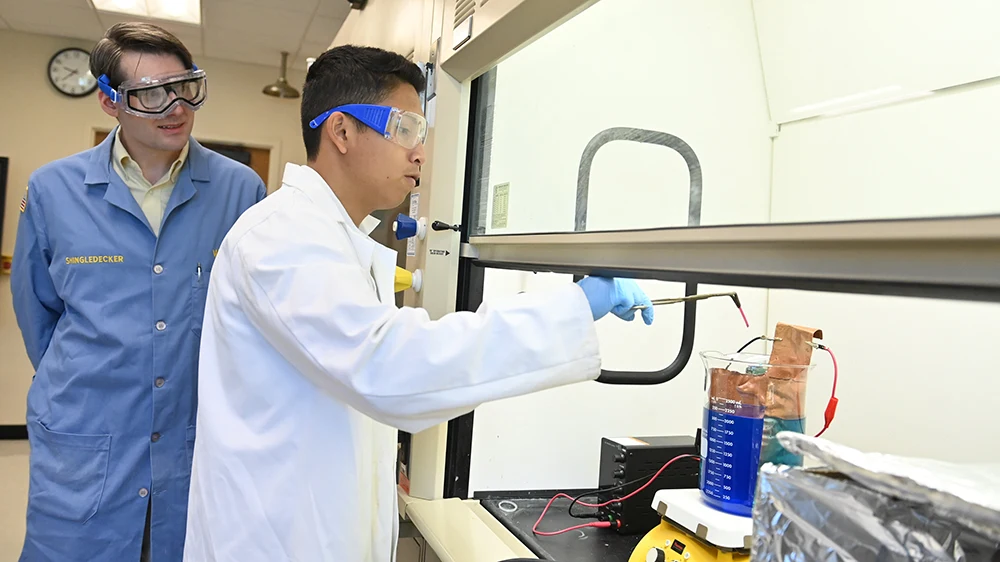
Cadet Uses 3D Printer to Make Prosthetic Bones
Cadet Xavier Zarza ’28 demonstrates the electroplating process while Maj. Christopher Shingledecker, Ph.D., observes.—VMI Photo by Kelly Nye.
Cadet Xavier Zarza ’28 demonstrates the electroplating process while Maj. Christopher Shingledecker, Ph.D., observes.—VMI Photo by Kelly Nye.
Imagine living in an impoverished country and being a parent of a child in need of a prosthetic bone. The cost of one prosthesis would be prohibitive, and over the lifetime of a developing child, it would have to be replaced multiple times to keep up with the child’s growth. Cadet Xavier Zarza ’28, a biology major, envisions a substantially less expensive alternative in his Summer Undergraduate Research Program project, “Electroplating 3D Prints for Antiseptic and Inert Properties in Prosthetics.”
3D printing is the process of creating three-dimensional objects from a digital file by building them layer by layer. Farming equipment, virtual reality simulators, nonessential car parts, and hobbyist models are all examples of ordinary items made from 3D printers. Zarza purchased a 3D printer for his own daily use in high school. He has designed his own prints using computer-aided design software and created many items, including fitted containers, fishing gear, a remote-control airplane, luggage ID tags, and planters.
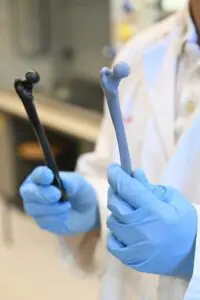
Zarza holds examples of 3D-printed bones.—VMI Photo by Kelly Nye.
The goal of Zarza’s SURP project is to provide low-cost prosthetics for use in developing countries that do not have access to high-tech facilities. His ideal production method should be simple enough to complete with readily available equipment, and capable of assisting a growing child needing replacements. He explained his process for designing and printing external and internal prosthetics. “I spent a lot of time with CAD software grafting the shapes and getting the right measurements,” explained Zarza. “I printed the prosthetics using two different substances: Polylactic acid, a non-conductive plastic filament; and ABS–like photopolymer resin, which is a light-sensitive material that mimics the durability and flexibility of ABS plastic. Resin printing requires three separate machines, while filament printing only requires one machine. The primary difference between the two materials is their strength. Resin is much stronger and smoother than filament, although prolonged exposure to resin is toxic to the human body.”
In addition to the toxicity of resin, Zarza observed metal plating would provide increased strength, sterility, and flexibility, as well as preventing cracking or deformation under a heavy load. Additionally, copper and gold contain antiseptic qualities. He was unsure, though, how to apply the metal. He came up with the idea of electroplating while conducting an experiment in his general chemistry lab course taught by Maj. Christopher Shingledecker, Ph.D., assistant professor of chemistry. “The experiment was on redox chemistry, where we were consuming part of a metal by dissolving it into solution. That’s essentially electroplating in reverse. Zarza very perceptively asked me if it could be run the other way—building the metal up instead of stripping it off—and I told him absolutely, that’s electroplating,” explained Shingledecker.
In order for the electroplating to be successful, Zarza first coated his prosthetic with low-electrical-resistance graphene. This enabled the electroplated metal to better adhere.
For his capstone project during the next academic year, Zarza will attempt to simulate gold-plated bones in the human body to ensure their safe use. If successful, he has no aspirations of selling his findings for personal gain. “The goal is to lower the cost and make it much more applicable for anyone else,” he said.
Zarza is from Lewisberry, Pennsylvania, where he attended Red Land High School. He is the son of Noel and Cecilia Zarza. He plans to commission into the U.S. Army Medical Corps.
Editor's Note: Story originally published by Virginia Military Institute.