Featured ArticleWhitney Matthews ’07:
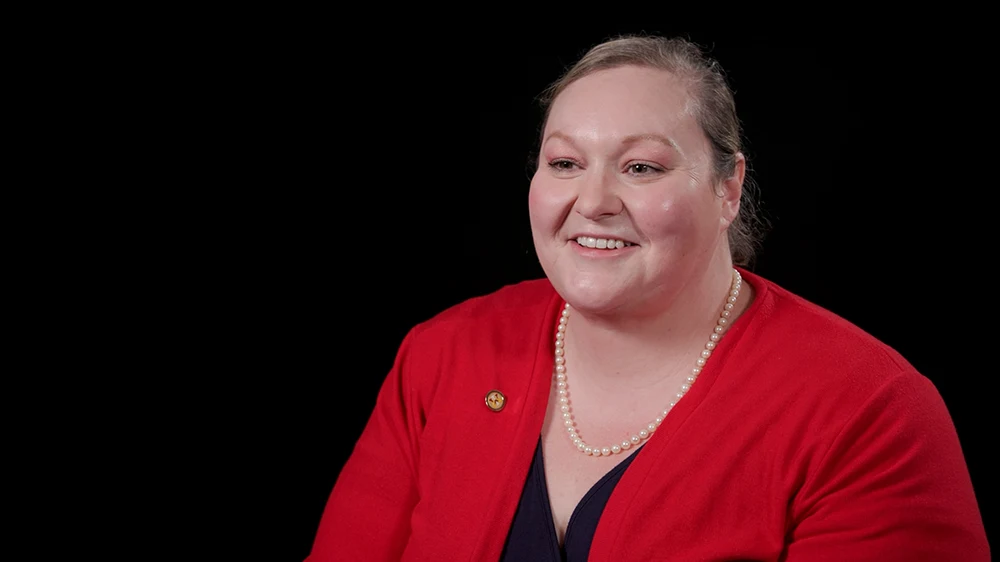
Whitney Matthews ’07 came to VMI on a dare—and it’s one she’s never regretted taking. Today, as an Alumni Association Board of Directors member, as well as the class agent for her class, she’s a passionate advocate for the Institute overall and alumnae in particular.
By the time she was a senior in high school, Matthews had determined her career path, and it wasn’t one that involved a traditional college or university. An aspiring chef, she’d applied and been accepted to culinary school. However, her private high school required seniors to apply to four colleges or universities, and because two uncles and a cousin had attended the Institute, she sent in her application there without too much thought.
“I didn’t realize how excited my mom was about it,” Matthews related. “She came when she got the packet, and interrupted my math class, pulled me out of math class, and I stood there and opened the packet, and she was so excited. And she told me that she wished she had been able to go to VMI because she wanted to be an engineer.”
Next, the Matthews family attended a VMI open house, which took place just after Breakout. The high spirits and sense of accomplishment emanating from the newly minted 4th Class left Matthews more open to attending VMI than she had been previously, but the deciding moment came when a high school classmate told her he’d also been accepted to the Institute.
“And I looked at him, and I said, ‘Oh, you did.’ I said I did too. And he turned his head, and he goes, ‘You at VMI—you wouldn’t last the first week.’ And in my brain, I was like, Is that a challenge? And I went home, and I asked my dad for the $300 deposit, and here we are,” Matthews recalled.
Arriving on post in fall 2003, Matthews found that the Rat Line was everything she thought it would be and more. “I did not understand somebody yelling in your face practically 24 hours a day, any time of the day— that was unexpected,” she commented. “When you see it on TV, you’re like, Oh, well, that’s just like 5 minutes. And it’s not like that. It’s constant. And you can get in trouble for any little thing.”
Despite the relentless nature of the Rat Line and the intensity of the VMI experience overall, there was never a time when Matthews wanted to leave. “I wanted to finish,” she said. “I wanted to prove to everyone that I did it. The person in my high school who said I couldn’t make it—he’s my brother rat.”
Matthews’ can-do attitude enabled her to thrive at a time when women at VMI were still considered somewhat of a novelty, and some doubted their ability to be successful. “I took it as motivation,” she stated. “And in my 3rd Class year, some of my brother rats were making fun of me because I couldn’t run as fast as they could. And it just clicked one day—okay, maybe I cannot run as fast as you can, but I am good at other things. I have strong academics. I have other talents, and you’re judging me on one property alone. … And what they don’t realize is they just kept pushing me to make sure I met my goal to graduate.”
Graduating with a Bachelor of Arts degree in history and modern languages, with a minor in English, Matthews returned to her dream of becoming a chef. While attending the Culinary Institute of America, which she described as “the Hogwarts of the culinary world,” Matthews found the Institute had prepared her better than she ever could have expected.
“I went to culinary school right after VMI, and you would get in the kitchen, and it’s male-dominant, and you have a chef yelling at you,” she stated. “And I can remember standing there being like, okay, the chef is yelling—what is he going to do? Make me do push-ups in the kitchen? … I’ve heard yelling for the past 4 years, and then I’m in another male-dominated industry. I can do this. I already proved it once. What’s going to stop me this time?”
“That VMI network—it’s everywhere, and that’s not something I ever thought I would be able to use going into the culinary world ... but that network stretches so far and in so many varied ways that I’m a big fan of the VMI network.”
Whitney Matthews '07
After finishing culinary school, Matthews accepted a position as a sous chef, and then she operated her own food truck, which she used to cater several rat send-off events in the Charlottesville, Virginia, area. All was going well until the COVID-19 pandemic hit, which entirely upended the food service industry.
But with Matthews’ VMI connections, she was prepared to pivot, and in 2021, she joined with George Inge ’91 and Guy Conte ’75 to open Taste Supply Inc., an e-commerce platform where small-to-medium-sized food makers can sell their products.
“That VMI network—it’s everywhere, and that’s not something I ever thought I would be able to use going into the culinary world,” Matthews noted. “You don’t really think VMI and culinary arts go together, but that network stretches so far and in so many varied ways that I’m a big fan of the VMI network.”
The strength of that network, even in an industry others might not associate with VMI, is something Matthews tries to convey whenever she speaks about the Institute.
“Even if you think you’re going into an industry that doesn’t have anything to do with a VMI network, I guarantee you there’s somebody who’s around that can help you,” she said. “And you just never quite know how those little dots add up.”
It’s a message she shares with cadets each fall at the Cadet–Alumni Career Networking Forum, an annual event sponsored by the Alumni Association.
“It’s about helping them really narrow down what they want to do,” she stated. “Some of them have ideas, and they just need an alum to talk to. We’re different from parents, we’re different from teachers, we’re different from professors, so we can kind of give a different perspective. And it’s just fun to be back at VMI.”
In September 2025, Matthews took her seat on the Alumni Association board as the Region IV mid-Atlantic regional director. “It’s important for me to be involved with the Alumni Association because I want to show other women that they can be involved, too,” she said. “It’s a little bit of a sore subject that sometimes women don’t feel represented by the Alumni Association here, and I want to help rectify that. I want to show girls who are in school that this is another option to think about, that VMI isn’t just for males, it is for females.”
Celebrating the extraordinary women who’ve chosen to attend the Institute has long been a passion for Matthews, and in fall 2022, she helped with the planning and execution of a very special event: the 25th anniversary of women matriculating at VMI.
“Bringing back a lot of the women from those early years and allowing us to interact together was not something that had happened before, and we actually got to talk to each other and reconnect and make new friendships,” she related. “When I think about the 25th anniversary, I always think about [Supreme Court Justice] Ruth Bader Ginsburg and her quote of wait and see, you’ll be proud of the female graduates of VMI, and I think that she would have been so proud to see a group of women coming together to celebrate these amazing achievements that they have.”
This year, she noted, the first female graduates of VMI, those from the Class of 2001, will celebrate their 25th Reunion. For Matthews, this milestone is a reminder that the earliest alumnae are reaching a consequential stage of life. “We’re just reaching that point in our careers where we can come back and start to give back to the Institute in more and better ways. And I see the 25th anniversary [of women] kind of kicking that off.”
-

Mary Price Development Writer/Communications Specialist
The development writer plays a key role in producing advancement communications. This role imagines, creates, and produces a variety of written communication to inspire donors to make gifts benefiting VMI. Utilizing journalistic features and storytelling, the development writer will produce content for areas such as Annual Giving, stewardship, and gift planning.

Victoria Raff Digital Content Strategist
The digital content strategist is responsible for creating compelling, audience-appropriate, multi-channel content for social media, and for monitoring the VMI Alumni Agencies' social media accounts. The strategist supports all communications efforts, including video editing, website updating, and email marketing deployment and training.