Featured Article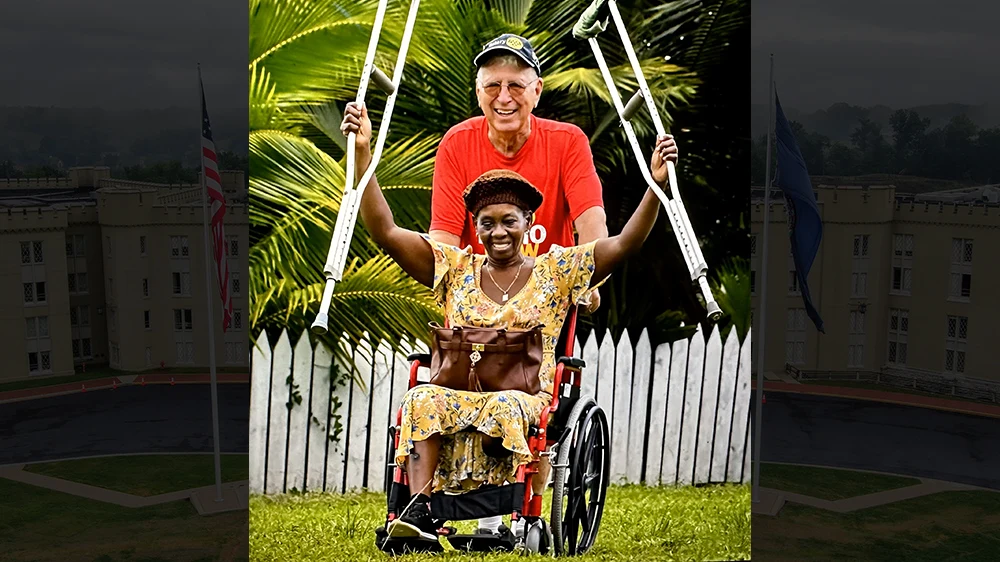
Sadler ’66: “A Mindset of Helping Others”
Woody Sadler ’66 with a grateful wheelchair recipient in Jamaica.—Photo courtesy Sadler.
Woody Sadler ’66 with a grateful wheelchair recipient in Jamaica.—Photo courtesy Sadler.
There aren’t many people who can say they’ve directly impacted 35,000 lives for the better—but in his quiet, unassuming way, retired U.S. Marine Corps Col. Woodson “Woody” Sadler ’66 has done just that. Over the past 12 years, through his work with Rotary International, Sadler and his fellow Rotarians from western Virginia have distributed more than 5,000 wheelchairs to individuals in 14 Latin American nations. Add in all the cadets Sadler taught during his 33 years teaching mechanical and civil engineering as an adjunct professor at VMI, and the number of lives he’s touched grows even larger, like an ever-expanding web.
“Service, I think, started here at VMI, and being in the military, you’re serving your countrymen, and it’s a nature of service,” said Sadler, whose path to a life of service began when he matriculated from Colonial Heights, Virginia, as an Army brat. Graduating from VMI with a Bachelor of Science degree in civil engineering and commissioning into the Marine Corps, Sadler spent one tour in Vietnam as part of a 28-year military career that took him to Guantanamo Bay, Cuba; Okinawa, Japan; Camp Pendleton, California; and many other locations around the world. Finally, life brought Sadler and his wife, retired U.S. Marine Corps Col. Lori Sadler, full circle, when he returned to Lexington as commanding officer of VMI’s Naval ROTC unit in 1992.
Moving to a new community, of course, brings new opportunities—and Sadler saw one when he arrived in Lexington. “When I came here as the professor of naval science, I said, ‘Well, I really ought to get involved with the local community here, because I’m no longer on a Marine base,’ and so the guy who built our house said, ‘Come to a Rotary meeting.’ So I did.”
Little did Sadler know when he arrived at that meeting that Rotary would provide a launchpad for several decades of service, but that’s just what happened. During the 1990s, he co-founded Lexington’s Sunrise Rotary Club, which organized the Fourth of July balloon rally held on the VMI Parade Ground for several years, and he also worked on a partnership between Rotary, Engineers Without Borders, and the VMI civil and environmental engineering department. Cadets designed and installed a water system in a remote Andean village in Bolivia at 15,000 feet. In 3 years, clean water brought the infant mortality rate from 60% to 20%. That project began his work toward what would become a signature project for himself and other Rotarians: Giving the gift of mobility and independence to individuals who might otherwise live their entire lives dependent on others.
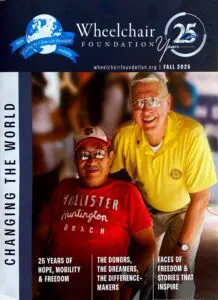
Woody Sadler ’66 is featured on the cover of the Wheelchair Foundation’s Fall 2025 magazine. The photo was taken at a distribution event in Ecuador in 2025.—Photo courtesy Sadler.
It was during his term as district governor of Rotary District 7570 in 2012–13 that Sadler first heard of Rotary International’s partnership with the Wheelchair Foundation, a Danville, California-based nonprofit dedicated to providing a free wheelchair to anyone, anywhere in the world who needs one. According to the Wheelchair Foundation, 80-100 million people worldwide need wheelchairs, and 65-95% of those who need one don’t have one. In Latin America, Sadler noted, the need is especially acute because of two factors: Diabetes, which often leads to amputations when untreated, and lack of prenatal care, which leads to birth defects.
Supplying the life-changing gift of mobility begins with money: Each shipping container of 270 wheelchairs costs $56,000, and once local Rotary clubs have raised $28,000, the Wheelchair Foundation matches that amount.
Known for its durable products, Drive Medical provides the wheelchairs. The chairs are manufactured in China, packed into containers, and shipped to the port of entry in each recipient nation. There, local Rotarians pick up the chairs and take them to a storage facility until Sadler and his fellow Rotarians arrive.
Then, what’s been up until then, a dry process of ordering durable goods, turns into magic. Wheelchair recipients, many of whom have spent their entire lives being carried by family members, are placed on one side of a large field, typically a soccer field, and the Rotarians on the other side. One by one, names are called, and as each recipient is brought forward, a Rotarian places them in their new chair. Emotions are high on both sides, and tears flow freely.
“So we always say that I take a bunch of people who attend Rotary meetings down with me, and I come back with true Rotarians,” said Sadler. “They actually see how their money is being spent, and they see how appreciative people are of what we’re doing, and how it makes a big difference.”
The multiplier effect of each chair is profound, rippling through families and communities. “The statistics say that for every wheelchair, there are seven people affected,” Sadler stated. “That’s the individual who gets the wheelchair and six caregivers. … So you take 5,000 wheelchairs and multiply them times seven. That’s the number of lives you’re actually affecting.”
Sadler’s quiet dedication over many years hasn’t gone unnoticed. At the end of March, Sadler was informed that he’d been selected for the Rotary International Service Above Self Award, which is the highest honor an individual Rotarian can receive. Out of 1.5 million Rotarians worldwide, only 150 are selected each year for this highest honor.
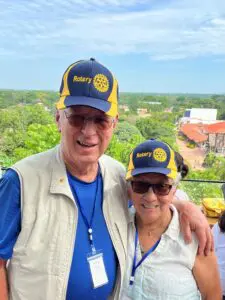
Lori and Woody Sadler ’66 in Bolivia in 2024.—Photo courtesy Sadler.
In addition to this top-tier award, which will be presented to Sadler this month, Sadler’s past awards include the Rotary International Meritorious Service Award, the Rotary International Cliff Dochterman Award for Distinguished & Dedicated Service to Scouting, the District 7570 Award of Excellence, the District 7570 110% Award, and the District 7570 District Governor’s Compass 2000 Award.
Being recognized is pleasant, but it’s not what keeps Sadler going through travel snafus, language barriers, and just the general difficulty of moving goods and people across continents. The gratitude that emanates from each recipient is palpable, he said, and so often, the recipients have never had any ability to control the placement of their bodies.
“It’s just when you go, and you put somebody, you lift somebody up and put them in a wheelchair, and they’ve never had any mobility in their life,” he commented. “We were in Cancun, and I lifted a 12-year-old girl out of a hammock where she had spent her whole life at that point, and now she had a wheelchair that she could move around in.” In Bolivia, he recalled, one recipient showed up being pushed in a wheelbarrow.
Closer to home, Sadler gave back to his alma mater for 33 years as an adjunct instructor, primarily teaching AutoCAD, a computer-aided design software for drafting and modeling, before he retired last year. In recognition of all he’d done for the Institute and cadets, Lt. Gen. David Furness ’87, superintendent, presented Sadler with VMI’s Meritorious Service Medal in December 2025.
Not surprisingly, Sadler said that being with cadets was his favorite part of teaching at VMI. “They say that being with young people keeps you young, and that’s true,” he stated.
“Being with the cadets and teaching them, especially when all of a sudden they’ve got a problem or something, and they say, ‘Oh yeah, I see,’ and their eyes light up,” he recalled. “It’s just very gratifying when that happens, so just seeing when they come in here at 17-18 years old, their long-term planning is 24 hours at the most; then, they come to graduate on time. They’re filled out physically and mentally. They’re talking about getting married, going into the service, going to graduate school, and really looking to the future. And the transition over the 4 years is just phenomenal. And I really enjoyed seeing that.”
During the dean’s end-of-semester reception, the event at which Sadler received the Meritorious Service Medal, he offered a few remarks, reflecting on six decades of involvement with the Institute’s unique brand of preparation for life. “I said I came to VMI, and as soon as I walked through the [Main] Arch, and they started yelling, I knew I was in the right place,” he stated.
“But then I said, VMI is a different college—says so on the website. It’s a different college. And you hear about requiring people to get haircuts and to shine shoes, to be in class on time. We’re making the cadets make decisions like, if you have an inspection coming up, you have to shine your shoes at the same time you’re going to have a test, you have to study for the test. You have to make a decision: You shine shoes, or you study for the test, and VMI teaches you to accept the consequences of your decision. You have to make your decision. You have to decide what’s important.”
For his part, Sadler is glad to see that cadets consider giving back to the community important, as they do during spring field training exercises. At VMI, he noted, “You get a mindset of helping others.”
The communications officer – features leads the creation of compelling, mission-driven written content that often supports fundraising and donor engagement efforts. In addition to crafting development-focused communications, this role contributes to the editorial success of key Alumni Agencies publications through strategic, long-form storytelling and by maintaining close working relationships with volunteer leaders.