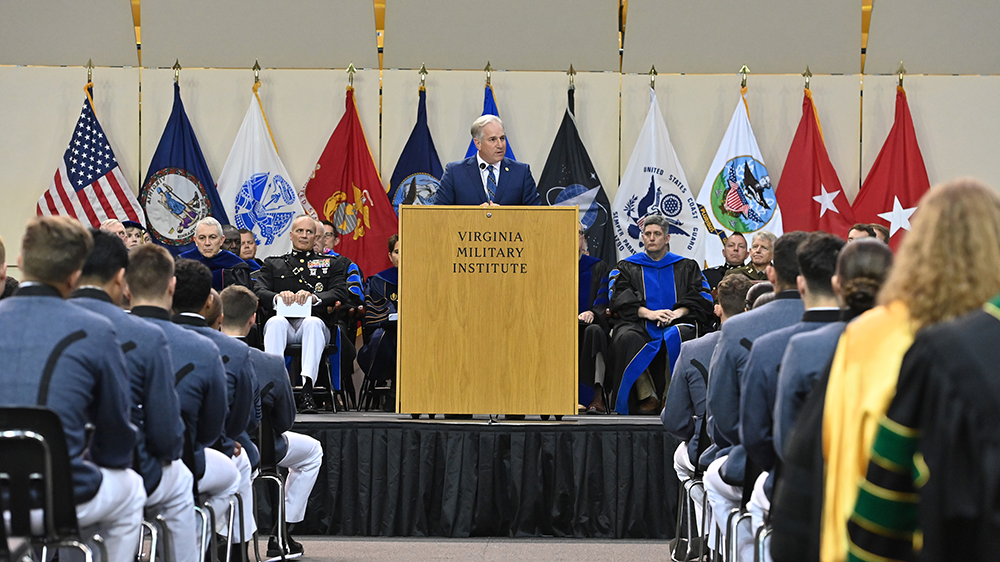
VMI opened its 187th year with a convocation ceremony, an annual tradition used to observe the opening of the academic year, in Cameron Hall Sept. 2, 2026. Guest speaker Douglas Bradburn, Ph.D., George Washington’s Mount Vernon president and chief executive officer, addressed the entire Corps of Cadets, members of VMI’s academic board, faculty and staff, and guests.
Brig. Gen. Robert Moreschi, Ph.D., dean of the faculty and deputy superintendent for academics, opened the observance by welcoming all assembled, especially the record number of rats at their first convocation. He thanked alumni and friends of VMI for their enduring support, recognized the academic star cadets seated in a place of honor, and acknowledged faculty and staff for their service to the Institute. He then invited Lt. Gen. David Furness ’87, superintendent, to the lectern to speak at his first convocation as superintendent.
Furness also greeted the audience and reminded the Rat Mass, embarking on its first academic year, of the many avenues VMI offers to pursue an education.“We host conferences; you may attend competitions, experiment in the laboratory, go on field training exercises, and travel abroad,” said Furness.
He then thanked the alumni and friends of the Institute for their continued support of the VMI Foundation, a key supporter of the programs. Furness also congratulated the cadets whose hard work earned them academic merit distinctions and challenged all cadets to strive for academic excellence.
“Set goals for yourself. Stay focused and strive to achieve these goals this academic year. Do not ever give up, and remember that excellence is a habit, not a singular act,” said Furness. He cited several programs VMI offers throughout the year to help cadets expand their knowledge, including those from the Center for Leadership and Ethics. Furness then introduced the guest speaker, Bradburn.
Bradburn opened his talk by asking the cadets what the 250th anniversary of the Declaration of Independence means to them as future leaders of this country, noting that even though 2026 is a year of celebration, there are irritations and challenges unique to this time.
“We are in the midst of a war. We have security challenges and all kinds of new things in cyber and AI that are going to frustrate us all. Partisanship is at an all-time high, some would say,” stated Bradburn. Instead of being angry and frustrated, he encouraged listeners to recognize the incredible story of the nation’s history.
Bradburn noted the 200th anniversary of American independence came right after the Watergate scandal. Similarly, at the centennial in 1876, the country was still scarred by the Civil War. Just 50 years after independence, the presidency had been so contested that it had to be decided in the House of Representatives.
“Then, of course, we go back to 1776 itself. The Declaration of Independence is a critical marker in that moment when this nation in rebellion had declared itself free and independent. But it’s a lot easier to declare independence than to win it,” noted Bradburn.
He described how the army under Gen. George Washington initially suffered major setbacks and defeats, but Washington, through the leadership skills he learned and developed, pressed on to victory.
Bradburn noted several lessons for cadets to glean from Washington’s example of leadership. The first lesson is to persevere and be resilient: “Winning independence was not inevitable,” said Bradburn. “It took extraordinary resilience and perseverance in the face of tremendous failure. Washington’s army would have to fight for 7 more years with privation, corruption, foolishness, mistakes, and a cause that became oftentimes unpopular. But they struggled through it. In some ways, perseverance in a higher cause is the highest form of courage. It’s one thing to step into the breach in a moment and show extraordinary valor, but the Continental Army was able to persevere day after day toward a vision to establish the liberty that we often take for granted in this nation.”