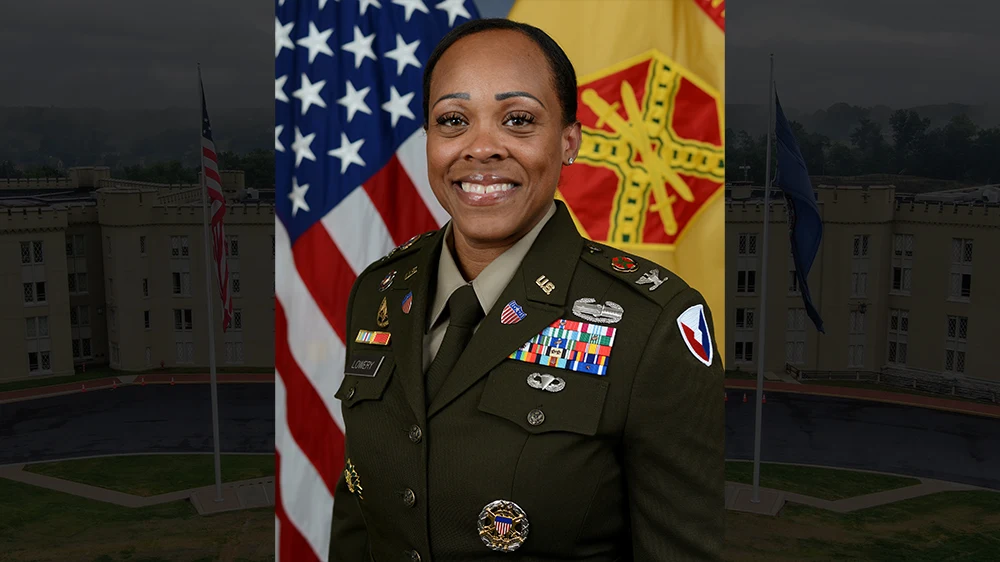
U.S. Army Col. Tasha Lowery ’02 has built her career around people—standing beside them, listening to them, and leading them.
For an adjutant general officer in the Army’s human resources branch, command opportunities are rare, but Lowery has managed to hold command at every level from company to battalion to brigade command. For her, holding command has been the best part of her career. “It has absolutely been the highlight of my career,” she says of being on the ground with soldiers and carrying out missions alongside them.
Lowery’s people-first leadership approach has shaped her military career, beginning with her cadetship and continuing into her current role as the colonels’ management chief, supporting the Army vice chief of staff in managing all Army colonels.
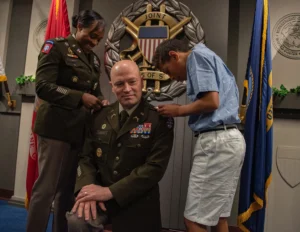
Lowery pins her husband, U.S. Army Chief Warrant Officer Five Shawn Lowery Sr., with the help of their son, S.J., at his change of command ceremony at the Pentagon in Washington, D.C., in May 2022.—Photos courtesy Lowery.
Her military career began early when, at 14 years old, she joined her high school’s JROTC program. Growing up in the small, rural town of Blackstone, Virginia, Lowery said the opportunities and personal development of the JROTC program were unmatched. “It was huge for me,” she stated.
Lowery also found a role model and mentor in her JROTC instructor, retired U.S. Marine Corps Master Gunnery Sgt. Harry Elliott. Inspired by Elliott, Lowery enlisted in the U.S. Marine Corps and began considering her next step when she received a call from a VMI alum about attending the Institute.
Matriculating in the second class of women, Lowery knew very little about VMI or the challenges awaiting her in the Rat Line. “I’m not going to sugarcoat it by any means: It was very challenging,” said Lowery. “I do think things were a bit more challenging as the school itself was figuring out how to matriculate women with the second class, so that made it difficult.” Her class began with more than 30 women and, by the end of 1st Class year, narrowed to fewer than 10 proud graduates.
What kept her going on the hard days was her determination, family, faith, and the strong bonds with her brother rats. For Lowery, there was never another option. “Determined, I think, is a good word for it. … The more someone says, ‘You can’t do something,’ for me, it’s like, ‘OK, I’m just going to show you,’” said Lowery. “There’s also something to be said when you’re surrounded by other people who are going through the same things you’re going through.” The small but intrepid group of female cadets, especially, supported each other throughout all 4 years of cadetship, and Lowery said they continue to connect annually to this day.
At the Institute, she balanced being a cadet-athlete on the track and field team, serving in the Marine Corps Reserve, and holding rank within the Corps. In her 1st Class year, Lowery became interested in military intelligence and decided to switch branches and commission as an Army officer. Upon graduating with a Bachelor of Arts degree in history, Lowery commissioned as an Army military intelligence officer. After 9 years in MI, she had the opportunity to switch branches and transitioned to her current branch in the Adjutant General Corps.
Her current role as the colonels’ management chief regularly splits her life between Fort Knox, Kentucky, and the Pentagon in Washington, D.C., and sends her all over the globe. Maintaining this isn’t without sacrifice, but she and her husband, U.S. Army Chief Warrant Officer Five Shawn Lowery Sr., make it work as parents of their 14-year-old son, S.J.—an avid hockey player—with the support of her mother, Lucy, who has lived with them for the past 10 years. “My mom is really the glue that keeps it all together,” said Lowery.
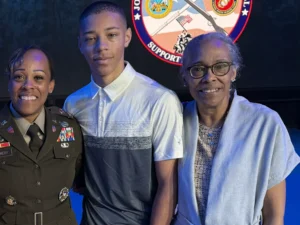
Lowery is pictured with her son, S.J., and her mother, Lucy, who Lowery describes as the “glue” of the family supporting their dual military household.
What she has loved most about her role, particularly in command, is the challenge of understanding the people and thereby how best to execute a mission. As an adjutant general officer in a commanding position, Lowery wears two hats: Understanding her soldiers is a more typical part of her human resources role, but she also balances that with her command role, needing to motivate them and successfully carry out missions. “I like understanding the folks [who] are behind the mission; I enjoy meeting people where they are, having conversations, [and] understanding the person,” said Lowery.
“There is a lot that goes into understanding who you’re commanding, and those things are important to successfully completing the mission,” continued Lowery. “It builds trust.” This mutual trust and being on the ground with soldiers is the most rewarding part of her role. “There’s just goodness for me in being around soldiers and being a part of change and implementation; it has absolutely been the highlight of my career.”
Her leadership style has always been a listen-first approach, and she says, “I think it’s easy, especially if you are put in a leadership position, to feel like when you go into a room that maybe you have to be the loudest voice in the room. And for me, I don’t believe that. … As a leader, if you start speaking, then I think it causes others in the room to remain silent.” She feels she can make the best decisions when she listens, and her decisions are informed by different perspectives and experiences.
Looking back, Lowery views her VMI education as integral to setting her up for success. “As I’ve gone on this military journey, there are things I learned from my time at VMI like the determination not to quit and the aptitude to just continue to ask questions if something doesn’t make sense—just to name a few. I’m 20-plus years into my Army career, and there are situations I find myself in, and I think, ‘I don’t know if I would be able to do this if it wasn’t for what my VMI experiences taught me.’ My VMI experiences have molded me to be the leader I am, as well as the person I am away from the military.”
When she reflects on her most poignant takeaway from the Institute, it naturally leads right back to people and the lifetime connections she made. “As I look back at VMI, the biggest takeaway for me is the friendships I still have. I have an amazing group of friends after 20-plus years. … We are all so very different, but the one thing that brings us back together is VMI.”
-

Mattie Montgomery Director of Publications
The director of publications oversees the Turnouts digital newsletter and supports a range of editorial projects that connect alumni and members of the VMI family and advance engagement and fundraising efforts. This role focuses on day-to-day content development, storytelling, and cross-departmental collaboration to ensure messaging remains consistent and effective.