Gary R. Kaylor ’62 will soon do something most men and women do at a much younger age: Retire from athletic competition. In late July, he will travel to Des Moines, Iowa, to participate in the National Senior Games, where he will play in his final formal basketball game. Making Kaylor’s retirement more interesting is that he did not begin playing on organized teams until he was 70 years old. And it’s surprising to learn that he did not play basketball—or any other varsity sport—at VMI.
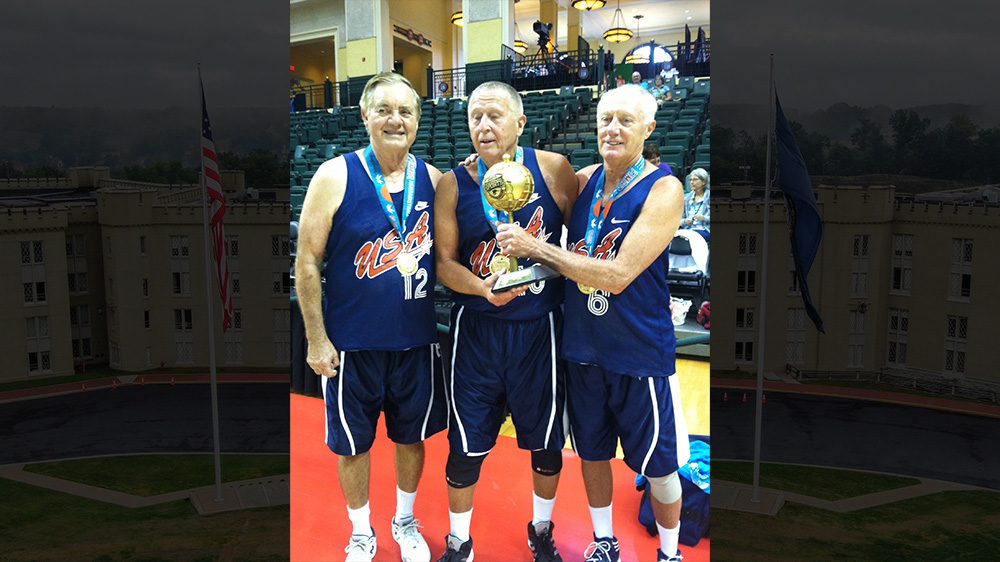
Not only did Kaylor start playing basketball competitively at 70, but he also became, well, a star. For example, he has medaled during the last seven National Senior Games. These games are played every other year, and a person must medal within a state championship tournament the previous year to qualify. Teams are broken down into age groups of 5 years apart and play half-court 3-on-3 basketball. Playing in the 70-74 division, Kaylor’s team won the silver medal in 2011 and 2013. In the 75-79 division, he earned a gold medal in 2015 and a bronze medal in 2017. In the 80-84 division, his teams received a gold medal in 2022 and a silver medal in 2023. At the 2025 games, Kaylor is registered to play in the 85-89 division.
After his team won the gold medal in 2015, he was invited to play on the 75-79 American team, playing in the biannual world championships organized by the International Maxibasketball Federation. This was something of a step up because, under FIMBA’s rules, the games are 5-on-5 and played on a full court. Kaylor competed at this level from 2015–23, and his teams were champions in all four events.
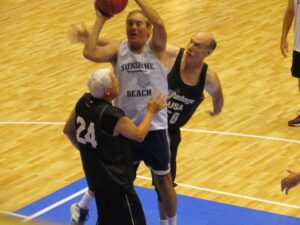
Although defended by two players, Kaylor takes a shot.—Photo courtesy Kaylor.
Kaylor played in five Master’s National 5-on-5 Tournaments in the 75-plus and 80-plus divisions, and his team won three gold medals and two silver medals. He was selected to the All-Tournament Team every year, and he was once the tournament’s most valuable player. He was the top scorer in his age bracket for two tournaments. He was also on teams that medaled in 33 state tournaments in six states, as well as playing seven times in the Huntsman World Games in Utah, which features one week of 3-on-3 basketball and one week of 5-on-5 basketball, and he participated in numerous county and master’s tournaments.
Although he started playing competitively at 70, Kaylor was not a late bloomer in terms of sports. In high school, he was a three-sport athlete. “I played end on my high school football team, center on the basketball team, and catcher on the baseball team,” he recalled. “Football was my best sport.” Kaylor’s talent was such that, in 1958, he was one of the five nominees for the award given to the best local high school athlete by the Roanoke chapter of B’nai B’rith, a Jewish organization that advocates for human rights.
Although several schools, including the University of Virginia, recruited him to play football, he decided to come to VMI on a state cadetship, which meant he had no obligation to play varsity sports. In the late 1950s, rats could not play varsity sports, so Kaylor tried out for rat football and rat basketball. But things did not pan out. “I was the original starter at right end [for football] until I suffered an injury, and I never played again.” In basketball, his height—6’2”—worked against him. “I was too short to play center at the collegiate level and, frankly, lacked the needed skills, too.”
Kaylor, therefore, concentrated on academics and played intramural athletics. “I did intramural wrestling and finished second in my weight class. I played company intramural football for Foxtrot Company. We won the championship for all 3 years, and I was the team’s captain during my 1st Class year. I also played on the company intramural softball team.”
After graduating from the Institute with a degree in chemistry, Kaylor spent 2 years in the U.S. Army as an artillery officer. After his military service, he started working for Shell Oil in Houston, Texas, and later earned a degree in chemical engineering at the University of Houston. He ended his professional career as Allied Signal’s manufacturing director for high performance fibers and retired on his 55th birthday.
Before retiring, Kaylor had played on company and church basketball teams, as well as pursued golf and tennis. After retirement, he started aerobic exercise and lifting weights at the gym. There, he joined people who were playing basketball at lunchtime every weekday. When he visited his daughter in Raleigh, North Carolina, he played with the retirees there twice a week. Many of these men were former college basketball players who were competing at the senior level in national tournaments. When Kaylor was 70, Howard Hurt, who had been the captain of Duke’s 1961–62 team, asked Kaylor to play on his team. “He told me he did so because I had defended him so well.” Kaylor would receive his first medal the next year, playing as a substitute on a team that lost the national championship in overtime.
Over the years, Kaylor has played on teams with 27 different players in the National Senior Games and 25 different players in the FIMBA World Championships. Besides Hurt, Kaylor has played with such college stars as Danny Sewell, who played at High Point College and was a First Team All-American for the National Association of Intercollegiate Athletics; Bill Hull, who led the ACC in rebounding his senior year at Wake Forest; Twig Wiggins, who was Billy Packer’s teammate at Wake Forest; and Jim Nuckols, who played for Lefty Driesell at Davidson, as well as Wally Jones, a former Philadelphia 76er.

In 2008, Kaylor hiked in Southeast Asia. Here, he is in the ruins of Thailand’s old capital, Ayutthaya.—Photo courtesy Kaylor.
“It was a pleasure playing with these guys,” said Kaylor. “They taught me proper ball rotation, how to make certain moves, and they gave me the incentive to make myself a better player.” To improve his skills, for 4 years, he practiced shooting, dribbling, and moving for 60–90 minutes a day. “During that time, I went from being a good defensive player and a decent substitute to being the leading scorer on the team that won the gold medal in 2015.”
Kaylor’s physical activity is not limited to basketball, however. Since retiring, he has devoted himself to at least 30 minutes of aerobic activity every day. “I also play some tennis and pickleball and work out regularly. I ride a bicycle, and I love hiking mountain trails. I also try to run for 30–45 minutes at least three times a week.”
He also has an adventuresome streak. “At the age of 67, I backpacked my way across South America for 3 months, using only local buses for transportation. I started in Quito, Ecuador, and went through Ecuador, Peru, Bolivia, Chile, Argentina, and Uruguay. In Ecuador, I hiked a volcano up to its snow line.” The next year, Kaylor did the same in Thailand and Laos, and his travels included spending 2 days going down the Mekong River in a small boat.
In 2017, Humana profiled Kaylor in an article on the merits of exercise for older adults. In it, he said, “My philosophy is don’t ever think old. Whatever you want to do—do it. Don’t let age get in the way!” Asked his meaning, he replied, “Look, everyone eventually will lose the ability to do certain things as they age, but it’s a lot better to lose it while trying to do things rather than losing it because you think you can’t.”
Asked if he has any advice with regard to staying active and fit, especially for those who are aging, he replied, “Anyone can be physically fit if they are willing to put the time into making it happen, and it pays huge dividends, physically and mentally, as you grow older.”