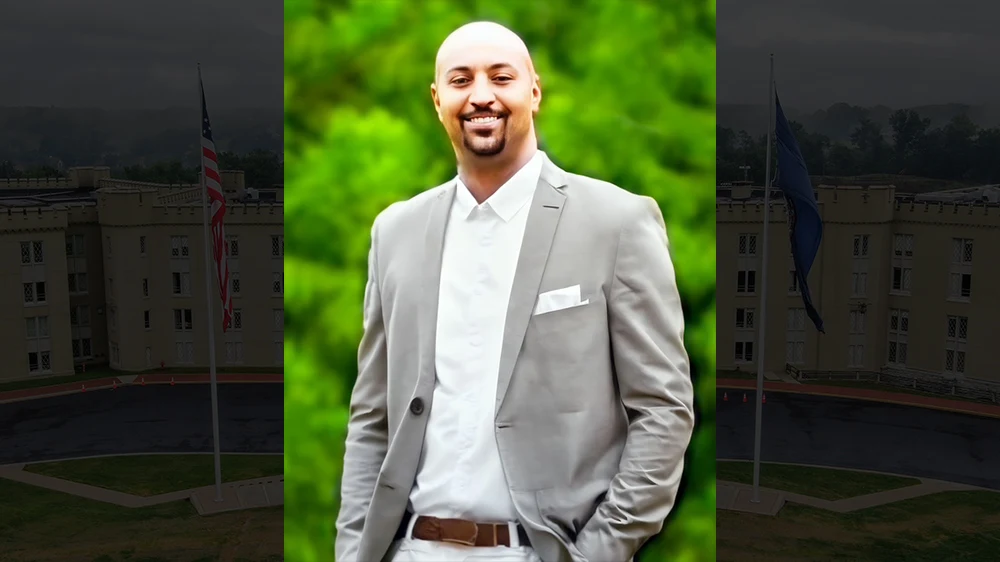
Jamel Lynch ’94 is a busy man. He heads a technology company and a beer distribution business. He is involved with several charities. In fact, when I first contacted him for this story, he replied while airborne over the Atlantic. Yet, as busy as he is, he was happy to slow down—albeit just a bit—to discuss his career and VMI.
Lynch first encountered VMI when he attended the College Orientation Workshop in 1989. According to Lynch, the experience “significantly influenced my decision to apply to VMI.” As he put it, it “pushed me outside of my comfort zone, both physically and mentally, while introducing me to life as a VMI cadet.
“Through daily calisthenics, I learned that without resistance, there is no strength, and that defeat can be an opportunity for education—if one chooses to learn from failure. I recognized that unexpected challenges often threw me off balance. However, these struggles motivated me to take on more difficult projects and embrace the process, ultimately helping me develop stronger problem-solving skills,” Lynch reflected.
During his senior year in high school, Lynch began to envision his future, and, during that time, he started to see VMI as “a natural fit.” To him, it was a place where he could build on what he had learned at COW. “VMI would let me build upon those experiences,” said Lynch. “It would be a training ground for personal refinement through discipline, handling difficult situations, and interacting with diverse individuals, and so a great preparation for my career.”
His family’s strong military background—his father and his maternal grandfather were both career military—also informed his decision. From their experiences, he knew a military college would have fewer distractions, as well as give him structure, focus, and self-discipline. “All in all, it would be a place where I would lay a strong foundation for leadership and success,” he said.
At VMI, Lynch was an electrical engineering major. “I wanted to take a challenging path to earn my degree,” he recalled, “and deepen my understanding of radio frequency technology. Additionally, I wanted to enhance my ability to solve complex and multifaceted problems. Electrical engineering offered me that and much more.”
Along with his academics, Lynch was involved and held leadership roles with the Institute of Electrical and Electronics Engineers, the Promaji Club, the Investment Club, and the Fellowship of Christian Athletes. He was also a triple jumper for VMI track and field. Asked how he was able to balance all these demands, he responded, “Simple: I sacrificed my free time. I slept less and accomplished as much as possible in a day.”
But the sacrifices were worth it, according to Lynch, as he met VMI’s many physical demands, developed leadership skills, and successfully pursued a challenging engineering education. VMI also taught him to keep striving to do better. “I was never satisfied with simply meeting expectations; the intensity of the experience drove me to continuously improve.”
After graduating from VMI, Lynch attended Virginia Tech to study for a master’s degree in electrical engineering. There, he found that his VMI experience prepared him well. “The academic rigor and disciplined approach to learning instilled in me a strong work ethic and an ability to manage my time effectively. The challenging coursework had taught me how to tackle complex problems and think critically, which made the transition to graduate school smoother.”
After Virginia Tech, Lynch immediately went to work in the field of high technology in North Carolina’s Research Triangle Park, a center of technological innovation. In July 1996, Lynch joined IBM’s Personal Computing Division and became involved in the integration of wireless technologies like Bluetooth and Wireless Wide Area Networking into IBM’s ThinkPad systems. He led a U.S.-Japanese development team that introduced these technologies into Japan and was the chairman of an advisory committee that developed next-generation PC card technologies. In 2003, he became a senior consultant and IT architect, specializing in strategic consulting and solution delivery.
Two years later, Lynch went to work for the IT firm Lenovo, first as a senior system engineer and, in 2009, as a global service account manager. He led the company’s engagements for many clients, including Booz Allen Hamilton, Accenture, Coca-Cola, World Bank, and the International Finance Corporation. His accomplishments include establishing a presence for the company in 70 countries, including 50 in Africa.
Lynch moved to Belden, Inc. in 2010, and over the next 3 years, he took on roles of increasing responsibility. He first served as a sales engineering director, working with clients in many diverse fields, including education, finance, and healthcare. As an acquisition integration manager, he took a lead role in a $40 million technology acquisition. From late 2011 to mid-2013, he led the company’s first North American technical services department that provided technical solutions in such industries as mining, transportation, and power generation. In July 2013, Lynch struck out on his own and established Nfinite Technologies, which provides business and technology services related to business continuity, remote workforce utilization, and virtual client engagement.
Mindful that he has spent more than 30 years in the technology industry, I asked Lynch what he believed was one of the more important developments in it. He pointed to Bluetooth. “Bluetooth was initially conceived to simplify wired connections and promote seamless communication between devices,” explained Lynch. “It now permeates daily life and is a fundamental component of countless devices we take for granted. This shift toward wireless technology has not only influenced consumer behavior but also driven innovation in industries such as automotive, healthcare, and what is known as ‘the Internet of Things.’”
“The academic rigor and disciplined approach to learning instilled in me a strong work ethic and an ability to manage my time effectively. The challenging coursework had taught me how to tackle complex problems and think critically.”
Jamel Lynch ’94
“Being involved in the tech industry has been both challenging and rewarding,” he said. Lynch’s participation included being awarded 20 patents related to Bluetooth. Asked about them, he replied, “Crafting patents requires a deep understanding of technology and foresight into its potential applications. It has been gratifying to see patented technologies come to fruition and make tangible impacts on the market and in everyday life.”
Over the course of his career, he has been recognized several times, including being named IBM’s Engineer of the Year and receiving its President’s Award for Continuous Improvement in Engineering. He was also the keynote speaker at a conference of the World Bank in Kigali, Rwanda.
Five years after founding Nfinite, Lynch established HB Distributing, specializing in distributing craft beer. He became interested in the industry through his work with Belden. “I spent considerable time collaborating with distributors, which gave me some insight into the industry. When the opportunity to distribute a unique craft beverage in two untapped markets presented itself—and no other distributor seemed interested in seizing it—I established a division within my company. One thing I enjoyed was collaborating with a local college’s marketing and logistics department and having its students help develop the blueprint to build out the business.”
Late last year, he created the Champion Distribution Group. Asked how the enterprise is going, he said, “We’re off to a very strong start and are already making a mark in North Carolina, Virginia, and some other markets. We’ve focused on building a portfolio of brands that stand out for quality and authenticity, and the responses from retailers and consumers have been exciting. Right now, we are focused on adding new partners and innovative beverages to our lineup.” When asked for an example, he pointed to Country Roads Golden Lager. “It’s quickly becoming a customer favorite. I like to think it’s solely because of the beer’s quality, but I must admit that many people probably give it a second look because of the enduring popularity of John Denver’s song,” said Lynch.
Lynch admits that the industry is fast-moving and competitive, but he is confident in the company’s future. “Our team is energetic and focused on our customers, and we have secured some major retail partnerships.” Asked if there is anything big in the offing, he laughed, “Yes, but, right now, let’s just say that we have some exciting announcements on the horizon.”
Somehow, Lynch has found the time to be involved in charitable work in the Raleigh-Durham area. Among them have been Southeastern Efforts Developing Sustainable Spaces or SEEDS, which is a 2-acre urban garden and kitchen classroom in Durham that introduces youth to growing, cooking, and sharing food, as well as Big Brothers-Big Sisters of Durham. “In my youth,” Lynch explained, “I spent a lot of time on a family farm, which taught me the value of hard work, and I had limited resources, which taught me the value of community support. We faced many challenges, but we always found ways to help each other out. That sense of community gave me a deep appreciation for the power of generosity and service. Engaging in charitable activities, therefore, is a way to help others who may be facing obstacles like those I experienced. I believe that everyone deserves a chance to thrive, and, through service, I can help give it to them.”
When I asked Lynch what lessons from his VMI experience he has applied, his answer was short: “Never Say Die! One of my strengths is that I rarely give up on solving problems. That ‘stick-to-itiveness’ I learned in barracks has never let me down.”
He was more garrulous when it came to advice he’d give to cadets. “First thing,” he said, “take every chance to develop your leadership skills. Whether through formal positions or simply stepping up in group projects, the experience will serve you well in your future. Next, focus on teamwork and learn to work effectively within diverse teams. Collaborating with peers will prepare you for the interdisciplinary nature of real-world projects. I also would urge them to prioritize time management. Balancing VMI’s rigorous academics with other responsibilities is challenging. So, it’s crucial to develop effective time-management techniques to avoid being overwhelmed.”
He also believes in the power of mentorship, saying, “A mentor can provide invaluable advice and perspectives as you navigate your time at VMI and afterward. It is important, therefore, that cadets seek and find mentors among faculty, upperclassmen, and alumni and, after you graduate, within your profession.” He also urges cadets to cultivate an enduring sense of curiosity. “It will drive you to continue to learn, whether through formal education or self-study.
“You also need to learn to network and otherwise build connections, be it with your classmates, professors, and industry professionals. Doing so will open doors to internships, job opportunities, and collaborative projects in the future. Finally, while it is important to focus on your studies and career, you need to take care of your physical and mental health. In barracks and afterward, make sure you engage in activities that help you unwind and recharge, whether they are sports, hobbies, or just socializing with friends. Your time in barracks is not just about academic and military achievement but also about personal growth and preparing for the rest of your life.”
Asked if he wanted to address something we hadn’t yet discussed, he said, “I mentioned how important COW was to me earlier. The man who established that program and runs it today is Gene Williams ’74, who the VMI Foundation will present its Distinguished Service Award to in November. Gene is the epitome of the qualities of VMI alumni, qualities that you only very rarely find in others. Alumni never quit. They always push forward and go past the mark. They are honorable. They embrace challenges, and they aren’t afraid to take calculated risks. They go out and do. If cadets develop these traits, these qualities, and pursue their passions relentlessly, they will make a difference. There is no way they won’t.
“It’s because of those qualities that the CDG is starting the Champion Most Valuable Intern Program for VMI cadets. I want to be clear that this program isn’t about encouraging drinking. It is about giving cadets the chance to apply their VMI experience in a real-world business setting, creating a bridge between VMI’s tradition of excellence and creating opportunities. I invite alumni to join us as partners in this program and help guide the next generation of leaders.”
-

Scott Belliveau '83 Communications Officer - Executive Projects
The communications officer supports the strategy for all communications, including web content, public relations messages and collateral pieces in order to articulate and promote the mission of the VMI Alumni Agencies and promote philanthropy among varied constituencies.