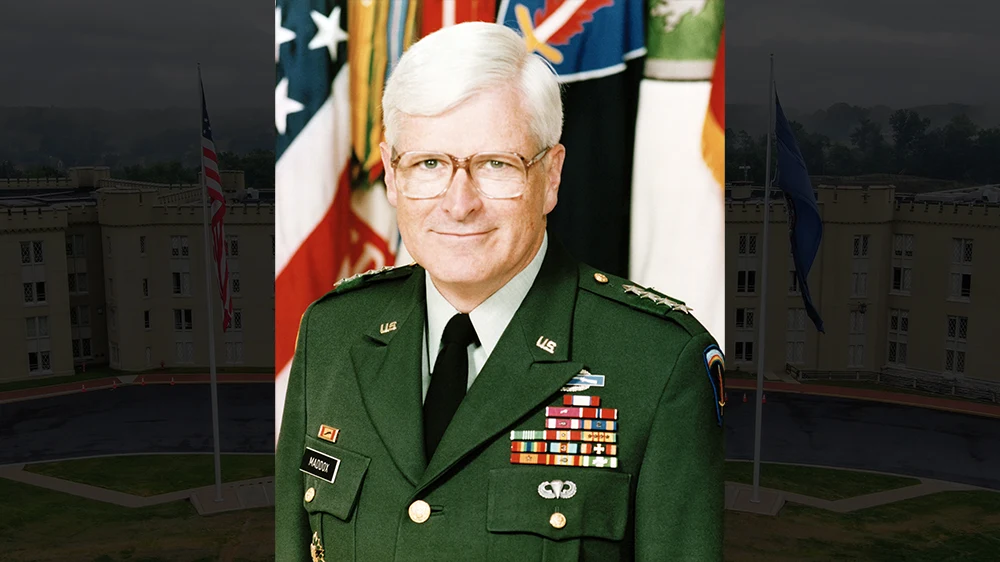
Retired U.S. Army Gen. David M. Maddox ’60 died Jan. 3, 2026. He was 87.
As a cadet, Maddox majored in mathematics and was a Distinguished Military Graduate. He was involved in many activities, including the General Committee and Executive Committee, The Cadet, his class’ Ring Figure Committee, the Timmins Music Society, and the Newman Club.
He held rank within Company F for 3 of the 4 years of his cadetship. In his 2nd Class year, he was its first sergeant and commanded it during his 1st Class year. Gen. J.H. Binford Peay III ’62, VMI’s 14th superintendent, recalled that Company F had a reputation of being “difficult to run.” Like Company A, it had “large, tall people, a lot of athletes, and other physically big men.” However, Maddox’s history in The Bomb noted his “devotion to duty is as real as death and taxes.” So, it is not surprising that, as Peay said, Maddox “achieved high standards.” Peay credited it to Maddox’s ability “to build teamwork, cultivate communications, and use the VMI reward system.”
Commissioned as an Armor officer, Maddox served 35 years in the Army. During this career, he served in various staff and command positions and commanded at every level from platoon to Army group. His first assignment was in Germany—he would serve there four times—with the 14th Cavalry Regiment, which he ended as a troop commander. He later led the 1st Squadron, 11th Armored Cavalry Regiment, the 2nd Armored Cavalry Regiment (1981–83), and the 8th Infantry Division (mechanized), as well as served as the assistant division commander (operations and training) of the 4th Infantry Division (mechanized). Maddox also served two tours in Vietnam, including one as a senior operations adviser with Military Assistance Command, Vietnam. Maddox’s soldiers admired his tactical ability and, because of his prematurely gray hair, gave him the enduring nickname “The Silver Fox.”
He earned a Master of Science degree in applied science (operations research) from Southern Illinois University in 1969. Recognizing his skill in that field and dedication to it, the Army assigned him to be the military assistant to the deputy undersecretary of the Army (operations research), as well as the deputy chief of staff for combat developments at the Army’s Training and Doctrine Command. He would also later be the commanding general of the service’s Combined Arms Operations Research Activity at Fort Leavenworth, Kansas.
Maddox assumed commanded the Army’s V Corps in Germany in November 1990 and served in that position until June 1992. The following month, Maddox was promoted to general and became the commander-in-chief of the U.S. Army Europe, commander of the U.S. Seventh Army, and the Commander of NATO’s Central Army Group. He would serve in that role until December 1994.
The end of the Cold War posed many challenges to the Army. For example, its presence in Europe declined from approximately 250,000 personnel in 1991 to less than 100,000 3 years later, and many of its bases closed. However, there remained a demand for well-trained and well-equipped forces to conduct contingency operations in various theaters. Maddox received accolades for his application of operations research to ensure that the budgetary pressures on the Army as a whole—and his command in particular—did not reduce the combat capabilities of American units based in Europe.
Maddox received many awards for his service, including two awards of the Army Distinguished Service Medal, the Legion of Merit, the Meritorious Service Medal, and the Air Medal. He also received the Bronze Star and earned the Combat Infantryman Badge and the Basic Parachutist Badge.
“General Maddox was a most exceptional and talented soldier and a gifted graduate.”
Walton M. Jeffress Jr. ’68
After he retired from the Army in 1995, Maddox became an independent consultant to industry and government. He was a member of the Defense Science Board, a senior fellow of the Army Science Board, and served as chairman of the board of Army Science and Technology. He was also on the board of the Charles Stark Draper Laboratory and the Washington Institute of Foreign Affairs.
He was elected a member of the National Academy of Engineering in 2004 in recognition of his many contributions to the field of operations research and his long-term focus on applying it to the Army’s operations and planning. In October 2007, Maddox was on a six-member panel that examined procedures for appointing and supervising contracting officers within the Department of Defense, which produced a report detailing many proposed reforms. He was later part of a team that examined the Army’s acquisition policies and processes.
The Military Operations Research Society recognized Maddox’s contributions to the field by presenting him with its Wanner Award, and the Institute for Operations Research and the Management Sciences awarded him its J. Steinhardt Prize for his leadership in the application of operations research to military challenges. He was also a member of the Army Operations Research Society Hall of Fame.
Maddox served the Institute as a VMI Foundation Board of Trustees member from July 2002–June 2010. He was a member of numerous committees, including the Executive Committee, the Finance Committee, the Strategic Planning Committee, and the Nominating and Awards Committee. During his 2 years of service on the Fundraising and Stewardship Committee, he was chairman of its annual giving subcommittee. He was so devoted to the subcommittee’s work that he frequently traveled to post to speak with cadets about the importance of private financial support to VMI—and their future role in providing it as alumni.
“General Maddox was a most exceptional and talented soldier and a gifted graduate,” said Walton M. Jeffress Jr. ’68, who served as a Foundation trustee from 2003–16 and was the organization’s president from 2011–14. “During his service as a trustee, his enthusiasm, comprehensive recommendations, and sound guidance helped the board improve its performance and the Foundation significantly increase donations in support of VMI from multiple sources.”
Maddox married his wife, Ethelmary (née McCleskey), in June 1968. She survives him, as well as four children and 15 grandchildren.
-
Scott Belliveau '83 Communications Officer - Executive Projects
The communications officer supports the strategy for all communications, including web content, public relations messages and collateral pieces in order to articulate and promote the mission of the VMI Alumni Agencies and promote philanthropy among varied constituencies.