Featured Article
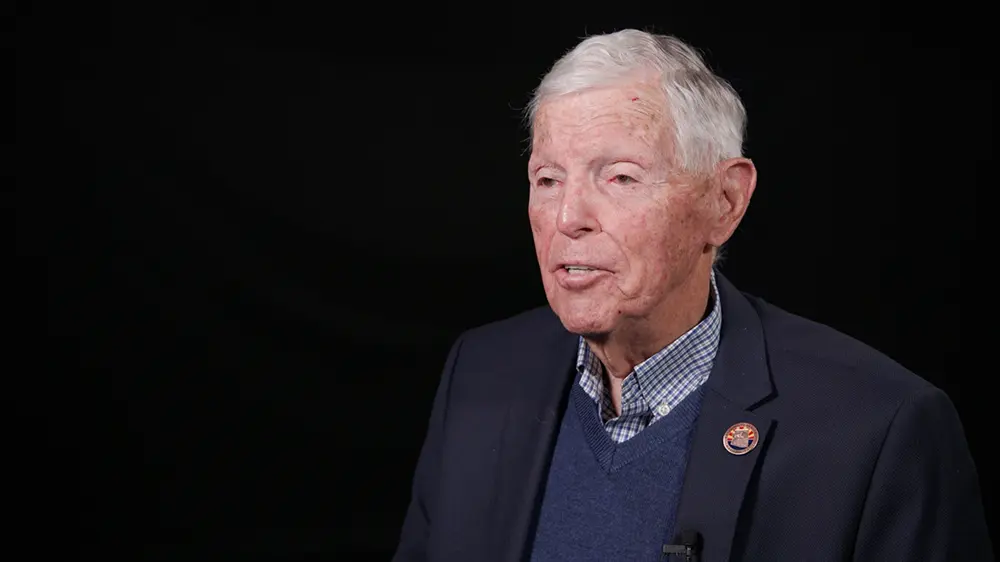
Bound, gagged, and blindfolded after being captured by the North Vietnamese, retired U.S. Air Force Col. Thomas H. “Tom” Kirk Jr. ’50B was only alive because his plan to commit suicide had failed. He’d been shot down on his 67th mission, a bombing run targeting the heavily defended city of Hanoi, Vietnam, and while he’d pulled out his weapon after bailing out of his burning F-105 Thunderchief and landing in a field, he’d soon lost consciousness and been unable to carry out his intention to shoot himself.
Now, he was in the Ho Loa Prison, better known as the Hanoi Hilton, but the joking nickname does a disservice to the hundreds of American service members who suffered and, in many cases, died there. One in three Americans held prisoner by the Viet Cong died in captivity—but although he would be held captive for 5 and a half years, with 2 of those years in solitary confinement, Kirk would not be one of them.
Today, at age 96, Kirk is living his best life in Anthem, Arizona, a suburb of Phoenix. Still vibrant and active, he walks without a cane, and at the Class of 1950B’s 75th Reunion in April 2025, he joined Brother Rat Bob Lynd ’50B in climbing the stairs to the sentinel box to lead an Old Yell for their class. Traveling with his wife, Ann, and playing golf are still very much a part of his life, and Kirk credits VMI with helping to instill the discipline that would see him through a period of unimaginable darkness and despair.
“I was in solitary [confinement] for 2 years, and I’ll tell you, if it hadn’t been for VMI and structure in my life and what discipline I had gained, I don’t know how I made it through, but VMI has always been a source of strength, a source of wisdom, and a source of discipline that I think so many people need so desperately in our youth today,” Kirk commented.
Growing up as an only child in Portsmouth, Virginia, Kirk didn’t plan to attend a military school, and he describes his path to VMI as the outcome of “pure chance.” His father was a machinist at the Portsmouth Naval Shipyard by day and a musician by night. The elder Kirk was a saxophone player, and his son began playing that instrument at the age of 5.
“By the time I got to high school, I was a pretty good musician, and that was my passion,” Kirk explained. Able to sight read with ease, Kirk was a called-upon gig musician, and on at least one occasion, he even played with the legendary Tommy Dorsey Orchestra during the heyday of big bands and swing music.
But while Kirk loved music, he knew the itinerant life of a musician wasn’t for him, and his mother had long harbored ambitions that her son would become a doctor. “When the time came to discuss college, my father and I sat down and he said, ‘You’re out an awful lot at night during high school. Maybe we should think about sending you to a military school to get some discipline because you need to study hard if you’re going to try and be a doctor.’”
At that point, a personal connection turned out to be a signpost pointing the teenage Kirk toward Lexington: An older friend, Hartwell “Hart” Sweeney ’46, told Kirk that VMI was a great school—although the rat year would be tough. Based on that recommendation, Kirk applied to VMI and was accepted.
Happily, Kirk arrived on post just as cadet musicians were replacing the adult volunteers who’d long provided an auditory backdrop to the rhythms of a cadet’s day.
“We started out with about 30-some people, and it was pretty rough in the beginning because a lot of the guys in there weren’t playing very well, but we went on. By the time I graduated, we had marched in two presidential parades, and I was also the lead tenor sax player in the band, the dance band, and so we went all over the state playing for the girls’ colleges and so on. And I loved that.”
But VMI, of course, wasn’t just about cranking out tunes. As a pre-med major, Kirk was spending most afternoons in the lab, and by the time he was a 1st Class cadet, he’d made a critical decision: Medicine wasn’t for him. “It was the first true decision I ever made in my life,” he stated. “I never wanted to be a doctor.”
At that point, Kirk made inquiries about commissioning and was told that while that was possible, he’d have to go to flight school.
“I’d never had a ride on an airplane, but at 20 years old, you’re willing to do most anything,” Kirk related. “So I went there, and it turned out I absolutely loved it. It’s the best decision I ever made. I stayed 28 years and loved every minute of it.”
As a newly commissioned second lieutenant in the U.S. Air Force, which at that time was less than 3 years old, Kirk wanted to learn to fly jets, but the jet school was full, so he was assigned the B-25 bomber instead. Once he’d mastered the technical skills of operating an aircraft, he set a goal of serving in Korea, where the war against Communist forces was still ongoing.
“Then and now, I believe with all of my heart that if you’re a career military person, and there’s a war on, you ought to be there,” he stated.
“I went to Korea early on, and I was what we call a mosquito pilot,” he continued. “I had an Army artillery observer in the back seat of my airplane, and we would fly up and guide and direct strikes of the dive bombers all along the front.”
But the lure of jet engines was still as strong as it had been back in the United States.
“I talked to every colonel I could,” he recalled. “I said, ‘Can you please help me get into fighters?’ And I feel certain I’m the only guy in the Air Force in the Korean War who did that. I’d never had a jet ride. And I talked my way into the fourth fighter wing at Kimpo Air Base.”
After Korea, Kirk had a variety of assignments, among them 6 years with a tactical fighter squadron based in Alexandria, Louisiana. However, he often found himself impatient with non-fighter assignments, such as being a test pilot or a maintenance specialist. When the United States entered the Vietnam War, Kirk was told he’d been selected as a C-123 Agent Orange spray pilot—and he balked. Then a lieutenant colonel, Kirk went to talk to his commanding officer and told him that if he couldn’t go to Vietnam as a fighter pilot, he’d retire from the service.
“...I’ll tell you, if it hadn’t been for VMI and structure in my life and what discipline I had gained, I don’t know how I made it through, but VMI has always been a source of strength, a source of wisdom, and a source of discipline that I think so many people need so desperately in our youth today.”
Col. Thomas H. “Tom” Kirk Jr. ’50B
Soon, an opportunity in that area opened up—but it was in Korea, not Vietnam. From Korea, Kirk kept an eye on the rapidly escalating situation in Southeast Asia, and by early 1967, he’d received an assignment to Takhli Air Base in Thailand, from which he and others conducted bombing runs over North Vietnam.
With adrenaline flowing, Kirk completed 66 successful bombing runs in the face of near-certain peril. “People don’t understand till you do it how fearsome that is because when you roll in, all 16 of us going together, and we’re flying 550 knots, going on a 45-degree angle, and you get about a third of the way down, and the entire world is shooting at you, and you see everything flying by. … There were 19,000 antiaircraft guns within a 45-mile circle of Hanoi. It was the most dangerous airspace in the history of modern air warfare.”
On Oct. 28, 1967, during Kirk’s 67th mission, he was the lead pilot on the largest bombing raid of the war so far—and his luck ran out. With his aircraft on fire, Kirk tried to make it 50 miles to the south because once he was over South Vietnam, fellow service members could assist pilots who’d been forced to bail out. But he only made it about 27 miles. With smoke pouring into the cockpit and the aircraft in a nosedive, Kirk had no choice but to eject.
“The last thing I remember was raising the seats and squeezing the handles. I was captured immediately.”
Because of how badly he’d landed, Kirk’s knees were injured, and he couldn’t walk for the first 2 months of his captivity. Struggling to find a way to keep going, mentally and physically, Kirk came to a realization.
“The days go by. All I can do is think about how everything’s gone. I’ve lost everything. What am I going to do? …Somehow, I dug deep and found the strength to bring my mind clearly to say, ‘I can do this. I can do this, and I will go home someday.’”
Kirk’s years at the Ho Loa Prison were made up of endlessly repetitive days, one exactly like the hundreds that had preceded it. To fill the empty hours and keep his mind focused, Kirk walked 4 miles each day in his 8-foot-long cell, but exercise burns calories, and calories were in short supply. Prisoners at Ho Loa were fed approximately 600 to 800 calories per day, and under those near-starvation conditions, Kirk’s weight dropped from 175 pounds to 90.
Sitting quietly, Kirk would pretend to play music. “I was able, of all things, to get my hand on a little stick about the size of my finger,” he explained. “And I played flute and clarinet, and I would spend 2 hours a day fingering scales on the flute and pretending like I was playing.”
Alone, Kirk held onto what he could recall from earlier days and happier times. “I think the single biggest thing in solitary was the learned mind control I found,” he continued. “Your mind starts to work. I could recall poetry. I could recall rules of VMI. I could recall books that I’d read. … And I’d built a regimen that came from VMI of what I would do each day.”
In early 1973, Kirk’s captivity finally came to an end, and his bravery was well rewarded: Among his awards and honors are the Air Force Cross (second highest for valor), four Silver Stars, two Distinguished Flying Crosses, two Legions of Merit, two Bronze Stars (one for valor), seven Air Medals, and a Purple Heart. As of this writing, Kirk is VMI’s most decorated living graduate and the most decorated VMI graduate of the Vietnam War.
In 1978, after having flown 22 different kinds of aircraft, Kirk retired from the Air Force—but as the military chapter of his life closed, other chapters opened. Over the past several decades, Kirk has been an entrepreneur, operating businesses both in the United States and in Europe, and his activities have included a little bit of everything, from serving as a financial planner to working as a ski instructor in Vail, Colorado—a gig he didn’t give up until he was 80.
Four years ago, Kirk was inducted into the Arizona Military Hall of Fame, and today, he dedicates a significant amount of time to giving talks and advocating for veterans. He’s also written an autobiography, “Hits, Misses, and Wins: A Fighter Pilot’s Life Story,” that’s available for purchase at Amazon.com.
When he speaks about his experiences, Kirk emphasizes the values he learned at VMI and how they stood him in good stead through a time when existence itself seemed to be a punishment. The Honor Code, above all, has been a guiding beacon, and so has the brother rat spirit.
“The values of going to VMI, the strengths of the Honor Code, not just the Honor Code about cheating …. Reporting yourself that you’re either in barracks or you aren’t, and knowing that friends, the guy next to you, your roommate, are going to take care of you. You’re going to take care of them. These are powerful things.”
Interviewed while he was on post for his 75th Reunion, Kirk shared that VMI will always hold a special place in his heart. “When I drive across that bridge coming in from Richmond, I kind of get a lump in my throat,” he said. “This place has a great deal of meaning to me because I saw myself as a poor country boy who came here and was turned into a man and a pretty proud one now. …The Lord has blessed me more than I could ever hope to ask for.”
Col. Tom Kirk ’50B reflects on the life lessons and values that helped him endure his time as a prisoner of war and offers advice to current cadets.
-

Christian Heilman Senior Director of Digital Strategy
The senior director of digital strategy is responsible for creating original video and multimedia materials, as well as developing and editing web and digital content. The senior director is responsible for platform coordination and troubleshooting, to include the VMI Alumni Agencies’ primary websites, digital newsletter and other digital platforms.

Mary Price Communications Officer – Features
The communications officer – features leads the creation of compelling, mission-driven written content that often supports fundraising and donor engagement efforts. In addition to crafting development-focused communications, this role contributes to the editorial success of key Alumni Agencies publications through strategic, long-form storytelling and by maintaining close working relationships with volunteer leaders.