At first glance, it’s easy to think the features that make VMI unique are the ones easily observed: Gothic Revival architecture, an emphasis on physical fitness, and a Spartan lifestyle marked by military discipline. Academics don’t come to mind quite as easily—but over the past 6 years, thanks to the support of alumni and friends of the Institute, VMI has quietly developed one of the nation’s few constitutional history programs offered by a liberal arts college.
“When this started, a driving idea was that 50 to 60% of our cadets go into the uniformed services and swear an oath to the Constitution,” said Brig. Gen. Robert “Bob” Moreschi, Ph.D., deputy superintendent for academics and dean of the faculty. “Another sizable percentage go to work for a three-letter agency and swear an oath to the same document. Given our mission to produce citizen-soldiers in support of American democracy, it made sense for our graduates to have a strong and significant understanding—a deep understanding—of the Constitution.”
The program was made possible by a gift from Conrad M. Hall ’65, a former member of the VMI Board of Visitors, VMI Foundation Board of Trustees, and VMI Investment Holdings, LLC. Since then, it has also received funding from other sources, including the Jackson-Hope Fund, which is dedicated to supporting academic initiatives at VMI.
Thanks to the impact of substantial private support, the constitutional history program begins in the classroom but goes far beyond the walls of Scott Shipp Hall. The class, History 300, U.S. Constitutional History, covers the history and legal and judicial interpretation of the U.S. Constitution, the document that has guided the federal government and provided civil rights and protections for U.S. citizens since the late 18th century.
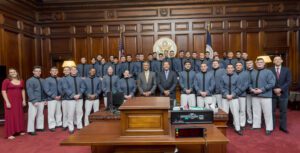
Cadets pose for a photo with Hon. James A. Wynn Jr. and Hon. Albert Diaz during a visit to the U.S. Court of Appeals for the Fourth Circuit in Richmond, Virginia, in 2024. Also pictured are Majs. Madeleine Ramsey and Bryant Etheridge, both assistant professors of history.—Photo courtesy Lisa McFarland, court photographer.
Leading the program—which provides field trips, speakers coming to post, and much more to enhance cadet learning—is Lt. Col. Mark Boonshoft, Ph.D., associate professor of history. Boonshoft, an early American historian who came to VMI in 2022 to head the constitutional history program, holds the Conrad M. Hall ’65 Chair in American Constitutional History.
The study of the U.S. Constitution begins, of course, with examining British constitutional traditions, since much of the U.S. government and legal system is based on British models. Then, Boonshoft explained, cadets delve into constitutional history questions in the news today, including but not limited to the Second Amendment, executive power, the Constitution in wartime, reproductive rights, religious freedom, and more.
“I joke every once in a while at the beginning of the semester that everything we talk about in this class is everything you shouldn’t talk about at Thanksgiving,” said Boonshoft. He’s quick to note, though, that the class is apolitical, and rather than focusing on cadets’ personal views on any contentious issue, discussion centers on what the Constitution has to say on the subject and how courts and Congress have interpreted that document.
“What we do when we tackle those themes is basically try to put in historical perspective the current controversy, or the current case, or the current debate,” said Boonshoft. “How did it evolve through the courts? How did it evolve through congressional action? How did it evolve through constitutional amendments? We try to give cadets a sense of how the Constitution—because it is amendable and its meaning is interpreted by the Supreme Court—has changed over time and what has forced or impelled those changes.”
Each time the course is taught, the topics covered shift slightly to highlight current events and special anniversaries. This spring, for example, capital punishment was a focus, as 2026 marks the 50th anniversary of Gregg v. Georgia, a landmark U.S. Supreme Court decision that reaffirmed the court’s support for the death penalty. There was also an emphasis on the American Revolution, with the nation marking the 250th anniversary of its independence this summer.
Because HI 300 is a discussion-based class with a heavy emphasis on assigned readings, class sizes are kept small, with most sections numbering 12 to 15 cadets. The class size cap is very intentional: Moreschi noted that smaller classes invite an exchange of ideas in ways that larger ones do not. “You’re not going to have a discussion with 40 people, but with 12 to 15, you can,” he observed.
Such small class sizes, while ideal for cadets, require substantial faculty support, so in addition to Boonshoft, other faculty teaching the class include Maj. Madeleine Ramsey, Ph.D.; Maj. Bryant Etheridge, Ph.D.; and Maj. Mattie Webb, Ph.D., all assistant professors of history. Moreschi noted that, for faculty, teaching this class for the first time requires extensive preparation, since there are no graduate programs that train constitutional historians.
Currently, more than a third of cadets are required to take the class, as it’s a requirement for those majoring in history, international studies, and economics and business. Pending funding, the long-term goal is to make HI 300 a requirement for the entire Corps.
Outside the classroom, cadets attend lectures and presentations by constitutional scholars and legal experts. Each September, a Constitution Day event is held on post commemorating the Sept. 17, 1787, signing of the U.S. Constitution. Notable events take place in the spring semester, as well, such as this spring’s program on the constitutional history of capital punishment in the United States.
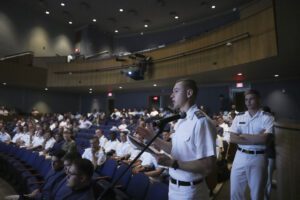
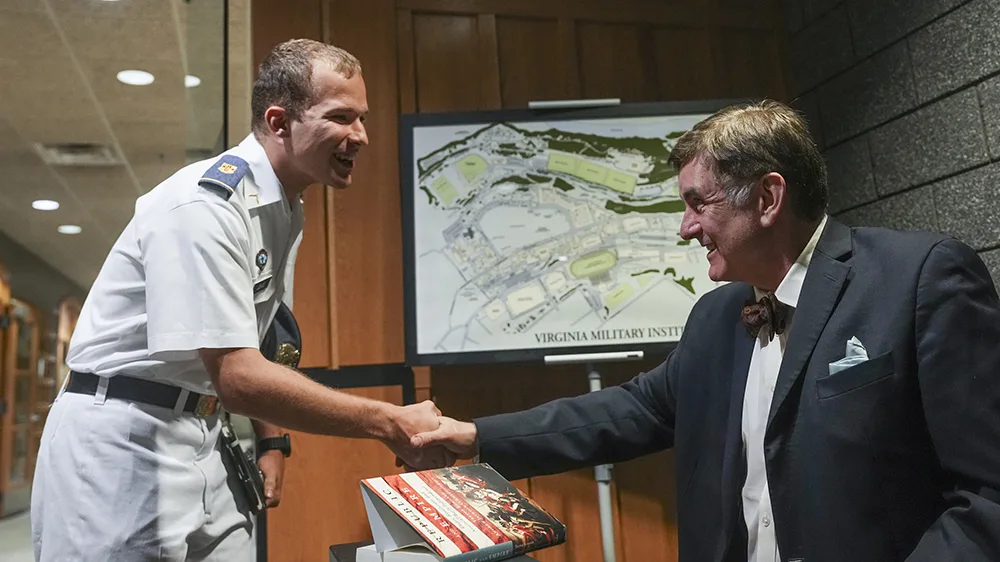
Cadets ask questions of Andrew J. O’Shaughnessy, historian and author, in Gillis Theater in Marshall Hall in September 2025. O’Shaughnessy’s visit to post was part of VMI’s observance of Constitution Day.—VMI Photo by H. Lockwood McLaughlin.
With support from the Jackson-Hope Fund, cadets even travel off post to attend oral arguments at the U.S. Court of Appeals for the Fourth Circuit in Richmond, Virginia. Almost always, judges make time after court proceedings are concluded to meet with cadets and answer questions. “These are some of the more powerful judicial figures in the country,” said Boonshoft. “[Going to the court] is something that can’t be recreated in the classroom—seeing the way judges are processing constitutional questions in real time. The sophistication with which these issues are adjudicated is something you can’t see in class.”
Hall, meanwhile, is delighted to see how far the program has come in the 6 short years since Col. Turk McCleskey, Ph.D., now professor emeritus of history, first taught a constitutional history course in fall 2020. “When I joined the [VMI] Board of Visitors in 2014, I noticed there was not an option to study how our democratic republic was structured and how it was intended to function,” he commented.
“It seemed to me that our graduates needed to know this—to know what they were being trained to protect and defend,” he continued. “This led to discussions with Dean Moreschi and others over a couple of years, during which time I proposed to fund a chair to help create the new course. Finding [Boonshoft] resulted in a magnificent addition to our faculty, and he has done a terrific job launching the new course. It is my hope that it will become a prerequisite for graduation, just like passing the swimming test. I am most grateful for the dean’s early enthusiasm and continued support.”
Moving forward, Moreschi hopes to have the financial resources to hire enough faculty to make the course mandatory for all cadets, while retaining the out-of-classroom features such as field trips that make the learning experience so unique. “We have the faculty nucleus, curriculum, and programming to eventually make HI 300 a foundational component of the core curriculum,” Moreschi stated. “As we progress in this direction, we believe this initiative will not only help VMI to better fulfill its mission to develop citizen-soldiers, but it will also be a model other colleges will seek to emulate within their own mission.”